Q1.
Which one of the following statements is true?
Q2.
With the propagation of a longitudinal wave through a material medium, the quantities transmitted in the propagation direction are
Q3.
A wave travelling in the +ve x-direction having displacement along y-direction as 1 m, wavelength 2π m and frequency of 1/π Hz is represented by
Q4.
Two waves are represented by the equations y₁ = asin(ωt + kx + 0.57) m and y₂ = acos(ωt + kx) m, where x is in meter and t in sec. The phase difference between them is
Q5.
A wave in a string has an amplitude of 2 cm. The wave travels in the +ve direction of x axis with a speed of 128 m/s and it is noted that 5 complete waves fit in 4 m length of the string. The equation describing the wave is
Q6.
The wave described by y = 0.25 sin (10πx – 2πt), where x and y are in meters and t in seconds, is a wave travelling along the
Q7.
The phase difference between two waves, represented by y₁= 10⁻⁶ sin[100t + (x/50) + 0.5] m and y₂= 10⁻⁶ cos[100t + (x/50)] m, where x is expressed in metres and t is expressed in seconds, is approximately
Q8.
A wave travelling in positive X-direction with a = 0.2 m, velocity = 360 m/s and λ = 60 m, then correct expression for the wave is
Q9.
In a sinusoidal wave, the time required for a particular point to move from maximum displacement to zero displacement is 0.170 s. The frequency of wave is
Q10.
The equation of a simple harmonic wave is given by \( y = 3\sin\frac{\pi}{2}(50t - x) \). The ratio of maximum particle velocity to the wave velocity is
Q11.
Sound waves travel at 350 m/s through a warm air and at 3500 m/s through brass. The wavelength of a 700 Hz acoustic wave as it enters brass from warm air
Q12.
A transverse wave is represented by \( y = A\sin(\omega t - kx) \). For what value of the wavelength is the wave velocity equal to the maximum particle velocity?
Q13.
A transverse wave propagating along x-axis is represented by \( y(x, t) = 8.0\sin(0.5\pi x - 4\pi t - \pi/4) \) where x is in metres and t is in seconds. The speed of the wave is
Q14.
A point source emits sound equally in all directions in a non-absorbing medium. Two points P and Q are at distances of 2 m and 3 m respectively from the source. The ratio of the intensities of the waves at P and Q is
Q15.
The equation of a wave is represented by \( y = 10^{-4}\sin\left(100t - \frac{x}{10}\right) \) m, then the velocity of wave will be
Q16.
A transverse wave is represented by the equation \( y = y_0\sin\frac{2\pi}{\lambda}(vt - x) \). For what value of \( \lambda \), is the maximum particle velocity equal to two times the wave velocity?
Q17.
The equation of a simple harmonic wave is given by \( y = 3\sin\frac{\pi}{2}(50t - x) \). The ratio of maximum particle velocity to the wave velocity is
Q18.
Sound waves travel at 350 m/s through a warm air and at 3500 m/s through brass. The wavelength of a 700 Hz acoustic wave as it enters brass from warm air
Q19.
A transverse wave is represented by \( y = A\sin(\omega t - kx) \). For what value of the wavelength is the wave velocity equal to the maximum particle velocity?
Q20.
A transverse wave propagating along x-axis is represented by \( y(x, t) = 8.0\sin(0.5\pi x - 4\pi t - \pi/4) \) where x is in metres and t is in seconds. The speed of the wave is
Q21.
A point source emits sound equally in all directions in a non-absorbing medium. Two points P and Q are at distances of 2 m and 3 m respectively from the source. The ratio of the intensities of the waves at P and Q is
Q22.
The equation of a wave is represented by \( y = 10^{-4}\sin\left(100t - \frac{x}{10}\right) \) m, then the velocity of wave will be
Q23.
A transverse wave is represented by the equation \( y = y_0\sin\frac{2\pi}{\lambda}(vt - x) \). For what value of \( \lambda \), is the maximum particle velocity equal to two times the wave velocity?
Q24.
A hospital uses an ultrasonic scanner to locate tumours in a tissue. The operating frequency of the scanner is 4.2 MHz. The speed of sound in a tissue is 1.7 km/s. The wavelength of sound in the tissue is close to
Q25.
The temperature at which the speed of sound becomes double as was at 27°C is
Q26.
Velocity of sound waves in air is 330 m/s. For a particular sound wave in air, a path difference of 40 cm is equivalent to phase difference of 1.6π. The frequency of this wave is
Q27.
A 5.5 metre length of string has a mass of 0.035 kg. If the tension in the string is 77 N, the speed of a wave on the string is
Q28.
If the amplitude of sound is doubled and the frequency reduced to one fourth, the intensity of sound at the same point will be
Q29.
The velocity of sound in any gas depends upon
Q30.
Two periodic waves of intensities I₁ and I₂ pass through a region at the same time in the same direction. The sum of the maximum and minimum intensities is
Q31.
Two waves having equation x₁ = asin(ωt – kx + φ₁), x₂ = asin(ωt – kx + φ₂). If in the resultant wave the frequency and amplitude remain equal to amplitude of superimposing waves, the phase difference between them is
Q32.
The equations of two waves acting in perpendicular directions are given as x = acos(ωt + δ) and y = acos(ωt + α), where δ = α + π/2, the resultant wave represents
Q33.
A tuning fork with frequency 800 Hz produces resonance in a resonance column tube with upper end open and lower end closed by water surface. Successive resonance are observed at length 9.75 cm, 31.25 cm and 52.75 cm. The speed of sound in air is
Q34.
A tuning fork is used to produce resonance in a glass tube. The length of the air column in this tube can be adjusted by a variable piston. At room temperature of 27°C two successive resonances are produced at 20 cm and 73 cm of column length. If the frequency of the tuning fork is 320 Hz, the velocity of sound in air at 27°C is
Q35.
The fundamental frequency in an open organ pipe is equal to the third harmonic of a closed organ pipe. If the length of the closed organ pipe is 20 cm, the length of the open organ pipe is
Q36.
The two nearest harmonics of a tube closed at one end and open at other end are 220 Hz and 260 Hz. What is the fundamental frequency of the system?
Q37.
The second overtone of an open organ pipe has the same frequency as the first overtone of a closed pipe L metre long. The length of the open pipe will be
Q38.
An air column, closed at one end and open at the other, resonates with a tuning fork when the smallest length of the column is 50 cm. The next larger length of the column resonating with the same tuning fork is
Q39.
A string is stretched between fixed points separated by 75.0 cm. It is observed to have resonant frequencies of 420 Hz and 315 Hz. There are no other resonant frequencies between these two. The lowest resonant frequency for this string is
Q40.
The fundamental frequency of a closed organ pipe of length 20 cm is equal to the second overtone of an organ pipe open at both the ends. The length of organ pipe open at both the ends is
Q41.
The number of possible natural oscillations of air column in a pipe closed at one end of length 85 cm whose frequencies lie below 1250 Hz are (Velocity of sound = 340 m/s)
Q42.
If we study the vibration of a pipe open at both ends, then the following statement is not true.
Q43.
The length of the wire between two ends of a sonometer is 100 cm. What should be the positions of two bridges below the wire so that the three segments of the wire have their fundamental frequencies in the ratio 1 : 3 : 5.
Q44.
When a string is divided into three segments of length l₁, l₂ and l₃ the fundamental frequencies of these three segments are υ₁, υ₂ and υ₃ respectively. The original fundamental frequency (υ) of the string is
Q45.
The time of reverberation of a room A is one second. What will be the time (in seconds) of reverberation of a room, having all the dimensions double of those of room A?
Q46.
If the tension and diameter of a sonometer wire of fundamental frequency n is doubled and density is halved then its fundamental frequency will become
Q47.
A string is cut into three parts, having fundamental frequencies n₁, n₂, n₃ respectively. Then original fundamental frequency n related by the expression as
Q48.
A standing wave having 3 nodes and 2 antinodes is formed between two atoms having a distance 1.21 Å between them. The wavelength of the standing wave is
Q49.
In a guitar, two strings A and B made of same material are slightly out of tune and produce beats of frequency 6 Hz. When tension in B is slightly decreased, the beat frequency increases to 7 Hz. If the frequency of A is 530 Hz, the original frequency of B will be
Q50.
Three sound waves of equal amplitudes have frequencies (n – 1), n, (n + 1). They superimpose to give beats. The number of beats produced per second will be
Q51.
A source of unknown frequency gives 4 beats/s when sounded with a source of known frequency 250 Hz. The second harmonic of the source of unknown frequency gives five beats per second, when sounded with a source of frequency 513 Hz. The unknown frequency is
Q52.
Two sources of sound placed close to each other, are emitting progressive waves given by y₁ = 4sin600πt and y₂ = 5sin608πt. An observer located near these two sources of sound will hear
Q53.
Two identical piano wires, kept under the same tension T have a fundamental frequency of 600 Hz. The fractional increase in the tension of one of the wires which will lead to occurrence of 6 beats/s when both the wires oscillate together would be
Q54.
A tuning fork of frequency 512 Hz makes 4 beats per second with the vibrating string of a piano. The beat frequency decreases to 2 beats per second when the tension in the piano string is slightly increased. The frequency of the piano string before increasing the tension was
Q55.
Each of the two strings of length 51.6 cm and 49.1 cm are tensioned separately by 20 N force. Mass per unit length of both the strings is same and equal to 1 g/m. When both the strings vibrate simultaneously the number of beats is
Q56.
Two vibrating tuning forks produce waves given by y₁ = 4sin500πt and y₂ = 2sin506πt. Number of beats produced per minute is
Q57.
Two sound waves with wavelengths 5.0 m and 5.5 m respectively, each propagates in a gas with velocity 330 m/s. We expect the following number of beats per second
Q58.
Two waves of wavelengths 50 cm and 51 cm produced 12 beats per second. The velocity of sound is
Q59.
A source of sound gives 5 beats per second, when sounded with another source of frequency 100 s⁻¹. The second harmonic of the source, together with a source of frequency 205 s⁻¹ gives 5 beats per second. What is the frequency of the source?
Q60.
A source of frequency υ gives 5 beats/second when sounded with a source of frequency 200 Hz. The second harmonic of frequency 2υ of source gives 10 beats/second when sounded with a source of frequency 420 Hz. The value of υ is
Q61.
Wave has simple harmonic motion whose period is 4 seconds while another wave which also possesses simple harmonic motion has its period 3 seconds. If both are combined, then the resultant wave will have the period equal to
Q62.
For production of beats the two sources must have
Q63.
Two cars moving in opposite directions approach each other with speed of 22 m/s and 16.5 m/s respectively. The driver of the first car blows a horn having a frequency 400 Hz. The frequency heard by the driver of the second car is (velocity of sound is 340 m/s)
Q64.
A siren emitting a sound of frequency 800 Hz moves away from an observer towards a cliff at a speed of 15 m/s. Then, the frequency of sound that the observer hears in the echo reflected from the cliff is (Take velocity of sound in air = 330 m/s)
Q65.
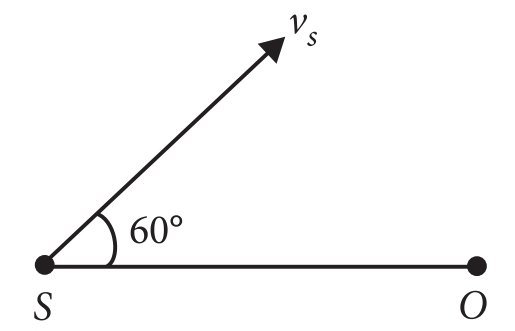
A source of sound S emitting waves of frequency 100 Hz and an observer O are located at some distance from each other. The source is moving with a speed of 19.4 m/s at an angle of 60° with the source observer line as shown in the figure. The observer is at rest. The apparent frequency observed by the observer (velocity of sound in air 330 m/s), is
Q66.
A speeding motorcyclist sees traffic jam ahead him. He slows down to 36 km/hour. He finds that traffic has eased and a car moving ahead of him at 18 km/hour is honking at a frequency of 1392 Hz. If the speed of sound is 343 m/s, the frequency of the honk as heard by him will be
Q67.
Two sources P and Q produce notes of frequency 660 Hz each. A listener moves from P to Q with a speed of 1 m/s. If the speed of sound is 330 m/s, then the number of beats heard by the listener per second will be
Q68.
A train moving at a speed of 220 m/s towards a stationary object, emits a sound of frequency 1000 Hz. Some of the sound reaching the object gets reflected back to the train as echo. The frequency of the echo as detected by the driver of the train is (Speed of sound in air is 330 m/s)
Q69.
The driver of a car travelling with speed 30 m/s towards a hill sounds a horn of frequency 600 Hz. If the velocity of sound in air is 330 m/s, the frequency of reflected sound as heard by driver is
Q70.
A car is moving towards a high cliff. The driver sounds a horn of frequency f. The reflected sound heard by the driver has frequency 2f. If v is the velocity of sound, then the velocity of the car, in the same velocity units, will be
Q71.
An observer moves towards a stationary source of sound with a speed 1/5th of the speed of sound. The wavelength and frequency of the source emitted are λ and f respectively. The apparent frequency and wavelength recorded by the observer are respectively
Q72.
A whistle revolves in a circle with angular speed ω = 20 rad/s using a string of length 50 cm. If the frequency of sound from the whistle is 385 Hz, then what is the minimum frequency heard by an observer which is far away from the centre (velocity of sound = 340 m/s)
Q73.
Two stationary sources each emitting waves of wavelength λ, an observer moves from one source to another with velocity u. Then number of beats heard by him
Q74.
A vehicle, with a horn of frequency n is moving with a velocity of 30 m/s in a direction perpendicular to the straight line joining the observer and the vehicle. The observer perceives the sound to have a frequency n + n₁. Then (if the sound velocity in air is 300 m/s)
Q75.
Two trains move towards each other with the same speed. The speed of sound is 340 m/s. If the height of the tone of the whistle of one of them heard on the other changes to 9/8 times, then the speed of each train should be
Q76.
In a guitar, two strings A and B made of same material are slightly out of tune and produce beats of frequency 6 Hz. When tension in B is slightly decreased, the beat frequency increases to 7 Hz. If the frequency of A is 530 Hz, the original frequency of B will be:
Q77.
The length of the string of a musical instrument is 90 cm and has a fundamental frequency of 120 Hz. Where should it be pressed to produce fundamental frequency of 180 Hz?
Q78.
Two vibrating strings A and B of same material but lengths 2L and 3L have radii 3r and 2r respectively. They are stretched under same tension. String A vibrates in fundamental mode and string B in second overtone. The ratio of their frequencies n_A/n_B will be
Q79.
If a pipe gives notes of frequencies 255, 425 and 595, what is fundamental frequency of the pipe and its type?
Q80.
If the initial tension on a stretched string is doubled, then the ratio of the initial and final speeds of a transverse wave along the string is:
Q81.
A string of length l is fixed at both ends and is vibrating in second harmonic. The amplitude at antinode is 2 mm. The amplitude of a particle at a distance l/8 from the fixed end is:
Q82.
An organ pipe filled with a gas at 27°C resonates at 400 Hz in its fundamental mode. If it is filled with the same gas at 90°C, the resonance frequency at the same mode will be:
Q83.
A pipe open at both ends has a fundamental frequency f in air. The pipe is now dipped vertically in a water drum to half of its length. The fundamental of the air column is now equal to:
Q84.
Given below are two statements:
Assertion (A): A glass tube partially filled with water represents an open organ pipe.
Reason (R): The open end corresponds to an antinode and the end in contact with water, to a node.
In the light of the above statements, choose the correct answer from the options given below:
Q85.
The displacement of a traveling wave is given by \( y = C\sin\left(\frac{2\pi}{\lambda}(at - x)\right) \) where t is time, x is distance, and λ is the wavelength, all in SI units. The frequency of the wave is:
Q86.
The ratio of frequencies of fundamental harmonic produced by an open pipe to that of closed pipe having the same length is
Q87.
The 4th overtone of a closed organ pipe is the same as that of the 3rd overtone of an open pipe. The ratio of the length of the closed pipe to the length of the open pipe is: