Q1.
A simple harmonic motion is represented by the function \( f(t) = 10 \sin(20t + 0.25) \). The amplitude of the SHM is
Q2.
Which of the following functions represents a simple harmonic oscillation?
Q3.
The motion of a particle varies with time according to the relation \( y = a \sin \omega t + b \cos \omega t \). Which statement is correct?
Q4.
Out of the following functions of time:
(i) \( \sin \omega t + \cos \omega t \)
(ii) \( \sin \omega t + \cos 2\omega t + \sin 4\omega t \)
(iii) \( e\^{-\omega t} \)
(iv) \( \log(\omega t) \)
The periodic motion can be represented by the functions:
Q5.
Which one of the following is not a periodic function?
Q6.
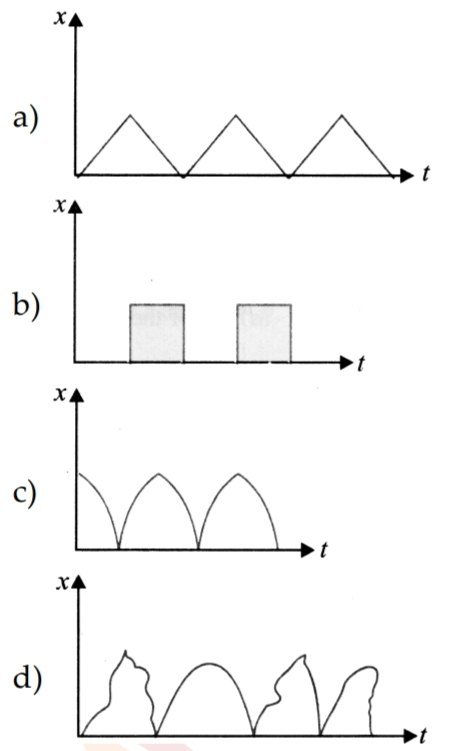
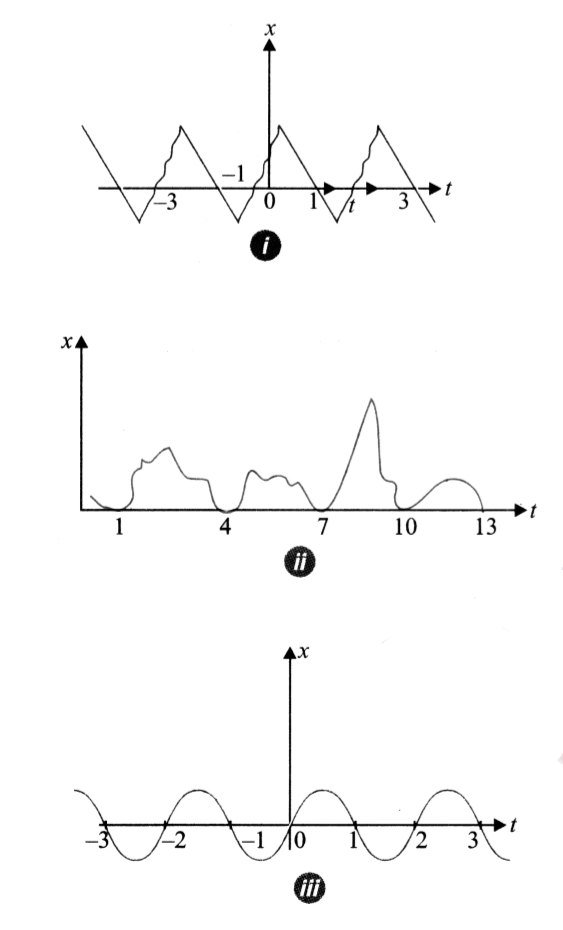
Which of the following x-t graphs does not represent periodic motion?
Q7.
The displacement of a particle varies according to the relation \( x = 4(\cos \pi t + \sin \pi t) \). The amplitude of the particle is
Q8.
There are two SHMs given by the equations:
\( x_1 = A \sin(\omega t + \pi/3) \)
\( x_2 = A \cos(\pi/3 - \omega t) \)
The phase difference between these two SHMs is:
Q9.
The displacement of a particle along the x-axis is given by \( x = a \sin\^2 \omega t \). The motion of the particle corresponds to:
Q10.
When two displacements represented by \( y_1 = a \sin \omega t \) and \( y_2 = b \cos \omega t \) are superimposed, the motion is:
Q11.
The equation of SHM is given as: \( x = 3 \sin 20\pi t + 4 \cos 20\pi t \), where x is in cm and t is in seconds. The amplitude is:
Q12.
Two SHMs are represented by the equations \( y_1 = 0.1 \sin(100\pi t + \pi/3) \) and \( y_2 = 0.1 \cos \pi t \). The phase difference of the velocity of particle 1 with respect to the velocity of particle 2 at t = 0 is:
Q13.
If two SHMs are represented by equations \( y_1 = 8 \sin(2\pi t + \pi/4) \) and \( y_2 = 2[\sin(2\pi t) + \sqrt{3} \cos(2\pi t)] \). The ratio of their amplitude is:
Q14.
A particle moves in x-y plane according to rule \( x = a \sin \omega t \) and \( y = a \cos \omega t \). The particle follows:
Q15.
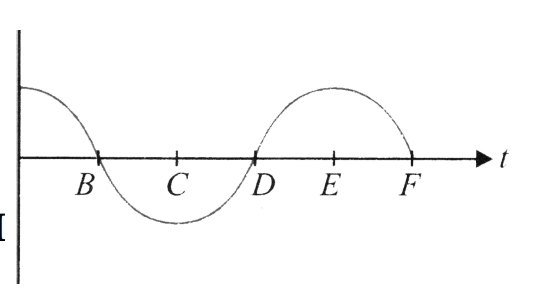
Displacement (x) – time (t) graph for a particle executing SHM is shown in figure. At what points the acceleration of the particle is zero?
Q16.
A particle performs SHM with a period of 2 seconds. The time taken by it to cover a displacement equal to half of its amplitude from the mean position is:
Q17.
A particle executes SHM with a period of T seconds and amplitude A metre. The shortest time it takes to reach a point \( A/\sqrt{2} \) from its mean position is:
Q18.
A particle executing SHM of amplitude 4 cm and time period = 4 s. The time taken by it to move from positive extreme position to half the amplitude is:
Q19.
If a simple harmonic motion is represented by \( \frac{d^{2}x}{dt^{2}} + kx = 0 \), where k is a constant. Its time period of oscillation is:
Q20.
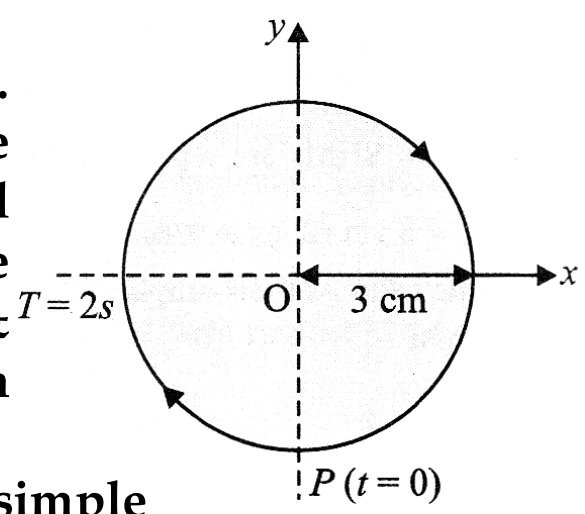
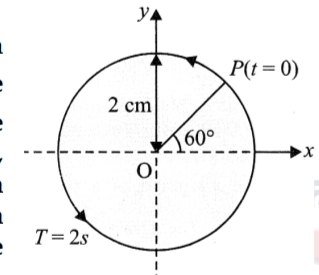
Figure shows a circular motion. The radius of the circle, the period of revolution, the initial position & sense of revolution are indicated on it. The corresponding simple harmonic motion of the x-projection of the radius vector of the revolving particle P is:
Q21.
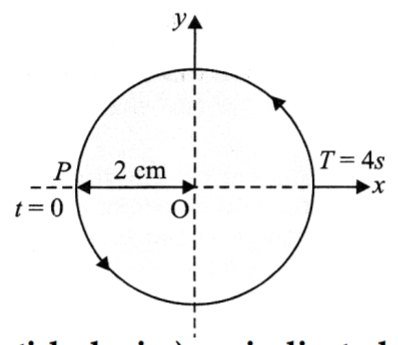
Figure shows the circular motion. The radius of the circle, the period of revolution, the initial position and the sense of the revolution (i.e. anticlockwise) are indicated on it. The corresponding simple harmonic motion of the x-projection of the radius vector of the revolving particle P is:
Q22.
Figure shows the circular motion of a particle. The radius of the circle, the period, sense of revolution and initial position of the particle are indicated in the figure. The simple harmonic motion of the x-projection of radius vector of the rotating particle P is:
Q23.
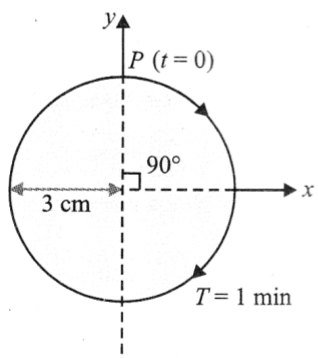
The figure shows a circular motion of a particle. The radius of the circle, period of revolution, the initial position and sense of revolution (i.e., clockwise) are shown on it. The corresponding simple harmonic motion of the y-projection of radius vector (in cm) of the revolving particle P is:
Q24.
A particle is executing SHM with amplitude A and has maximum velocity \( V_{0} \). Its speed at displacement A/2 will be:
Q25.
The acceleration of a simple harmonic oscillator is 1 ms^{-2}, when its displacement from the mean position is 0.5 m. Its frequency of oscillation is:
Q26.
The displacement of a particle in SHM is given by \( y = 4 \cos(2\pi t + \pi/4) \) m. The velocity of the particle in magnitude in SHM at time t = 3 s is:
Q27.
A particle executes SHM with an amplitude of 2 cm. When the particle is at 1 cm from the mean position the magnitude of its velocity is equal to that of its acceleration. Then its time period in seconds is:
Q28.
The x-t graph of a particle executing SHM is shown in figure. The acceleration of the particle at time t = 3/4 s is:
Q29.
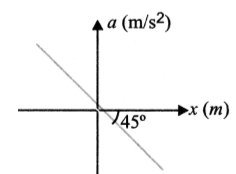
Acceleration (a) – displacement (x) graph of a particle executing SHM is as shown in figure. The time period of its oscillation in seconds is:
Q30.
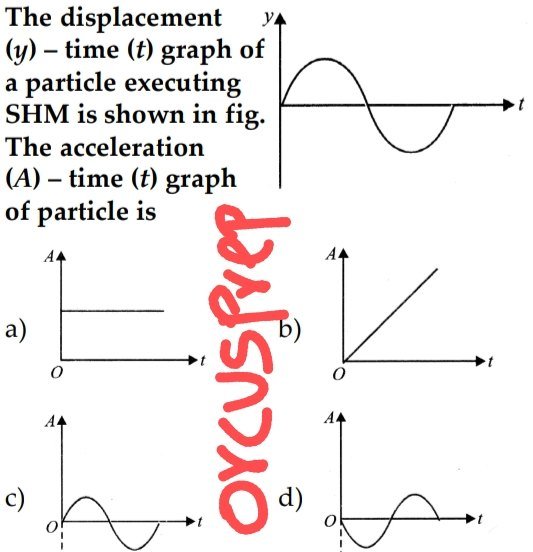
The displacement (y) – time (t) graph of a particle executing SHM is shown in figure. The acceleration (A) – time (t) graph of particle is:
Q31.
A particle is subjected to two mutually perpendicular SHMs such that its x and y coordinates are given by \( x = 4 \sin \omega t \); \( y = 2 \sin(\omega t + \pi/2) \). The path of the particle will be:
Q32.
A platform performs simple harmonic oscillations in a vertical plane. The amplitude of oscillations is 0.2 m. If a coin placed on the top is not to be separated from it, the least period of these oscillations is (g = 9.8 m/s^{2}):
Q33.
A block is placed on a horizontal surface is moving with simple harmonic motion of frequency 4 Hz. If the coefficient of friction between the block and the surface is 0.5, the maximum amplitude for which the block will not slip along the surface is [assume, g = 10 ms^{-2} and \( \pi^{2} = 10 \)]:
Q34.
A person of weight 50 kg stands on a board which oscillates up and down with a time period of 1 s and an amplitude 0.05 m. If g = 10 ms^{-2} and \( \pi^{2} = 10 \), then the maximum and minimum weights of person recorded by weighing machine on the board would be:
Q35.
The displacement of a particle executing SHM is given by, y = 12 sin (6t + π/4), where y is in metre and time t is in seconds. The initial displacement and velocity of the particle are respectively:
Q36.
The velocity vector v and displacement vector x of a particle executing SHM are related as \( v \frac{dv}{dx} = -\omega^{2} x \) with the initial condition v = v_{0} at x = 0. The velocity v, when displacement is x, is:
Q37.
A spring of force constant 1200 N/m is mounted on a horizontal table as shown in figure. A mass of 3.0 kg is attached to the free end of the spring, pulled sideways to a distance of 2.0 cm and released. It will execute SHM. Maximum speed of the mass is:
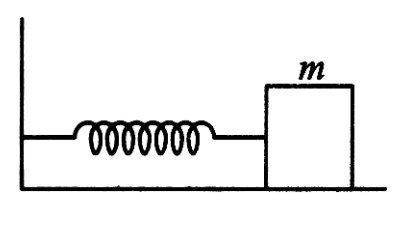
Q38.
For a simple harmonic oscillator, the potential energy is equal to kinetic energy:
Q39.
A particle of mass m oscillates with SHM between points x1 and x2, the equilibrium position being O. Its potential energy (PE) is plotted. It will be given below in the graph:
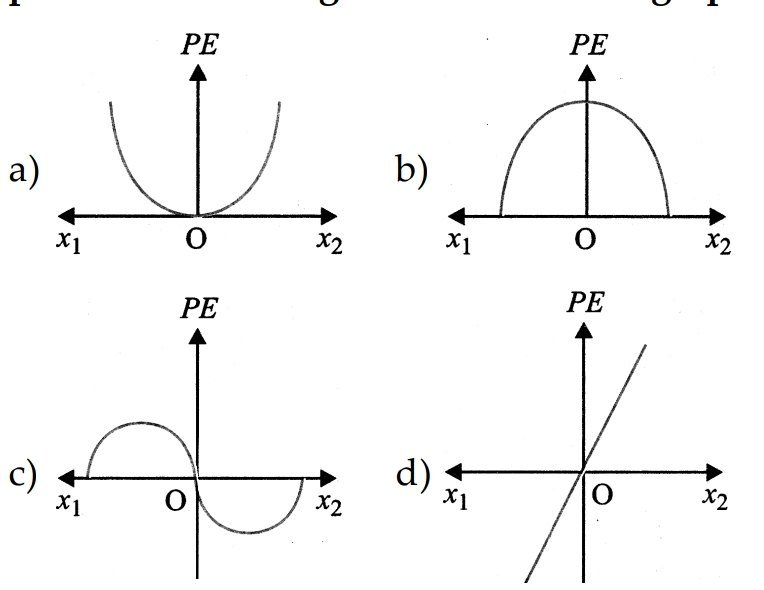
Q40.
A particle is executing simple harmonic motion with a time period T. At time t = 0, it is at its position of equilibrium. The kinetic energy-time graph of the particle will look like:
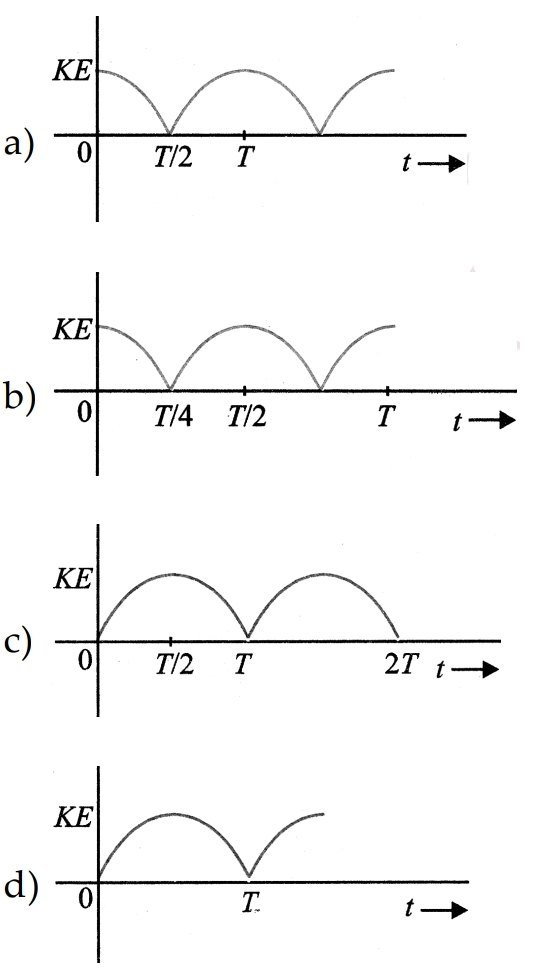
Q41.
The total energy of the particle executing SHM is E. What will be the PE and KE of the particle when displacement is half of the amplitude?
Q42.
The potential energy of a particle of mass 2 kg in SHM is (16x²) J. Here, x is the displacement from the mean position. If the total mechanical energy of the particle is 49 J, then maximum speed of the particle is:
Q43.
A small mass body attached to one end of a spring oscillates horizontally with SHM, with a frequency (1/2π) Hz and total energy 40 J. If the maximum speed is 0.8 m/s, the force constant of the spring and the maximum potential energy of the spring during this motion are:
Q44.
The displacement of a particle of mass 3 g executing simple harmonic motion is given by y = 3 sin (0.2t) in SI units. The kinetic energy of the particle at a point which is at a distance equal to (1/3) of its amplitude from its mean position is:
Q45.
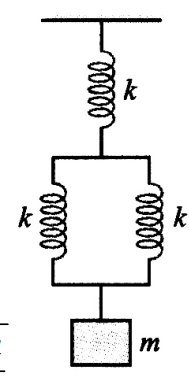
If ks and kp respectively are effective spring constant in series and parallel combination of springs as shown in the figure, find kp/ks:
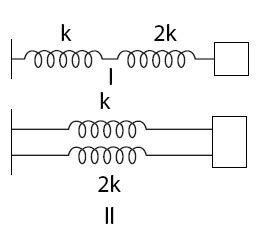
Q46.
Refer to figure, the time period of oscillation of the body of mass m is:
Q47.
If two springs A and B with spring constant 3k and k are stretched separately by same suspended weight, then the ratio between the work done in stretching A and B is:
Q48.
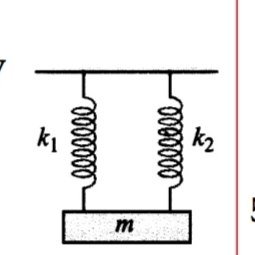
A mass is suspended separately by two springs of spring constants k1 and k2 in successive order. The time periods of oscillations in the two cases are T1 and T2 respectively. If the same mass be suspended by connecting two springs in parallel as shown in figure, then the time period of the oscillation is T. The correct relation is:
Q49.
When a spring is extended by 2 cm, the energy stored is 100 J. When extended by further 2 cm, the energy increases by:
Q50.
Starting from the origin, a body oscillates simple harmonically with a period of 2 s. After what time will its kinetic energy be 75% of the total energy?
Q51.
An object of mass 200 g is attached to the end of vertical suspended spring. If the mass is pulled down through a distance 8.0 cm and let it go, it oscillates with a frequency 4.0 Hz. The spring constant of the system is:
Q52.
A mass m is suspended from one end of a spring of spring constant k. The time period of oscillation of mass is T. If the spring is cut into four pieces, what will be the force constant of each part and what will be the periodic time, if the same mass is suspended from one piece?
Q53.
A simple pendulum is made of a body which is a hollow sphere containing mercury suspended by means of a wire. If a little mercury is drained off, the period of oscillation will:
Q54.
A girl is swinging in a swing in a standing position. If she sits and swings, what will be the effect on period of swing?
Q55.
The length of a simple pendulum is increased by 44%. What is the percentage increase in its time period?
Q56.
The time period of a simple pendulum inside a stationary lift is 5 second. What will be the time period in second when the lift moves upwards with an acceleration of g/4?
Q57.
A simple pendulum of frequency n falls freely under gravity from certain height from the ground level. Its frequency of oscillation will:
Q58.
If a body is released into a tunnel dug along the diameter of the earth of radius R_{0}, it executes SHM with time period:
Q59.
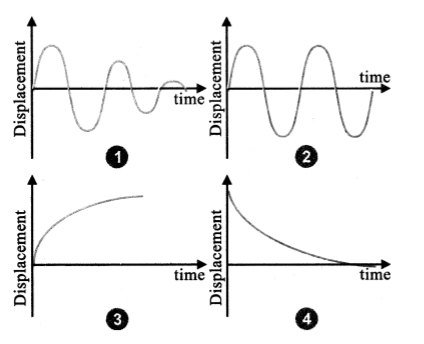
Which of the following figure(s) represent(s) damped simple harmonic motion?
Q60.
Due to damping of SHM, which of the following characteristic does not change?
Q61.
A particle is oscillating under a force \( \vec{F} = -(kx + bv) \), where k and b are constants. The oscillation of the particle is:
Q62.
When a damped harmonic oscillator completes 100 oscillations its amplitude is reduced to 1/3 of its initial value A_{0}. What will be its amplitude when it completes 300 oscillations?
Q63.
For the damped oscillator, the mass m of the block is 200 g, k = 90 Nm^{-1} and damping constant b is 40 gs^{-1}. The period of oscillation is:
Q64.
Which of the following x-t graphs for linear motion of a particle represent periodic motion along with its period of motion?
Q65.
A particle executing SHM along Y-axis has its motion described by equation, y = A sin(ωt) + B. The amplitude of the SHM is:
Q66.
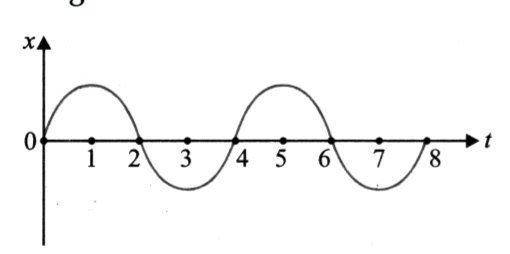
The displacement (x) – time (t) graph for a particle in SHM is shown in figure. Which of the following statement is correct?
Q67.
Which of the following functions of time represent simple harmonic motion?
Q68.
The function \( \cos^{2} \omega t \) represents:
Q69.
Two particles A and B describe SHM of same amplitude a and frequency v along the same straight line. The maximum distance between the two particles is \( a\sqrt{3} \). The initial phase difference between the particles is:
Q70.
The displacement-time equation of a particle executing SHM is \( y = a \sin(\omega t + \phi) \). At time t = 0, position of the particle is y = a/2 and it is moving along negative y-direction. Then, the angle φ will be:
Q71.
The displacement of two particles executing SHM are represented by equations \( y_{1} = 2 \sin(10t + \theta) \) and \( y_{2} = 3 \cos 10t \). The phase difference between the velocity of these particles is:
Q72.
A particle is executing simple harmonic motion with a period of T seconds and amplitude a metre. The shortest time it takes to reach \( \frac{a\sqrt{3}}{2} \) from its mean position in seconds is:
Q73.
A body oscillates with SHM according to the equation (in SI units), \( x = 5 \cos\left(2\pi t + \frac{\pi}{4}\right) \). Its instantaneous displacement at t = 1 second is:
Q74.
Two simple harmonic motions are represented by \( y_{1} = 4 \sin\left(4\pi t - \frac{\pi}{2}\right) \) and \( y_{2} = 3 \cos(4\pi t) \). The resultant amplitude is:
Q75.
A mass m = 100 g is attached at the end of a light spring which oscillates on a frictionless horizontal table with an amplitude equal to 0.16 metres and time period equal to 2 sec. Initially the mass is released from rest at t = 0 and displacement x = -0.16 m. The expression for the displacement of the mass at any time (t) is:
Q76.
A particle oscillates in a straight path so that its acceleration A is given by A = -kx, where x is the displacement from the equilibrium position and k is a constant. The period of oscillation is:
Q77.
A body describes simple harmonic motion with an amplitude of 5 cm & a period of 0.2 s. The acceleration and velocity of the body when displacement is 3 cm are:
Q78.
A particle is executing SHM along a straight line. Its velocities at distances x_{1} and x_{2} from the mean position are v_{1} and v_{2} respectively. Its time period is:
Q79.
Two simple harmonic motions are represented by the equations \( y_{1} = 0.1 \sin\left(100\pi t + \frac{\pi}{3}\right) \) and \( y_{2} = 0.1 \cos\left(\pi t + \frac{\pi}{3}\right) \). The phase difference of the velocity of particle 1 with respect to the velocity of particle 2 at time t = 0:
Q80.
A body of mass 5 gram is executing SHM about a fixed point O. With an amplitude of 10 cm, its maximum velocity is 100 cm/s. Its velocity will be 50 cm s^{-1} at a distance (in cm):
Q81.
A particle is executing SHM along a straight line. Its period of oscillation is 2 s and amplitude is 12 cm. Its velocity when it is at 4 cm from the extreme position, is:
Q82.
Velocity of a particle at an instant in simple harmonic oscillation is given by \( v = \sqrt{144 - 16x^{2}} \text{ ms}^{-1} \), where x is in metre. The maximum velocity of that particle is:
Q83.
The equation of motion of a particle executing SHM is a + 16π²x = 0. In this equation a is a linear acceleration in ms^{-2} of the particle at a displacement x metres. The time period of SHM in seconds is:
Q84.
A block of mass M rests on a platform. The platform is given up and down SHM with an amplitude a. What is the maximum frequency of oscillation of the platform at which the block does not leave the platform?
Q85.
The simple harmonic motion of a particle is represented by the equation \( x = 4\cos\left(88t + \frac{\pi}{4}\right) \). The frequency (in Hz) and the initial displacement (in m) of the particle are:
Q86.
Which one of the following equations of motion represents simple harmonic motion?
Q87.
Two mutually perpendicular SHMs are simultaneously acting on a particle. These SHMs are in phase, having frequency ratio 1:1 and have unequal amplitudes. The particle will execute:
Q88.
When a particle oscillates simple harmonically, its kinetic energy varies periodically. If frequency of the particle is f, the frequency of the kinetic energy is:
Q89.
The amplitude and angular velocity of a simple pendulum are a and ω respectively. At a displacement y from the mean position, the ratio of kinetic energy K and potential energy U of pendulum bob is:
Q90.
A simple pendulum of length L has an energy E and amplitude a. The energy of the simple pendulum when length is doubled but with same amplitude is:
Q91.
Average value of kinetic energy and potential energy over entire time period in a SHM is:
Q92.
A point particle of mass 0.1 kg is executing SHM of amplitude 0.1 m. When the particle passes through the mean position, its KE is 8 × 10^{-3} J. The equation of motion of this particle, if its initial phase of oscillation is 45° is:
Q93.
A uniform spring of force constant K is cut into two pieces, the lengths of which are in the ratio 1 : 2. The ratio of the force constants of the shorter and longer piece is:
Q94.
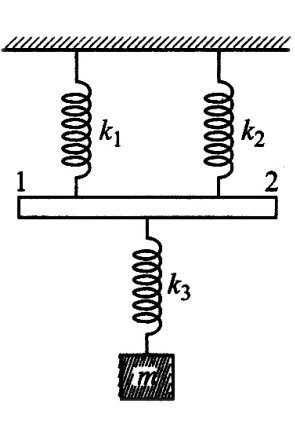
A weightless bar is supported by two springs of spring constant k₁ and k₂ as shown in figure. A mass m is suspended from the bar through a spring of spring constant k₃. The natural time period of oscillation of the mass is:
Q95.
A mass M is suspended from a vertical spring of negligible mass. The mass is pulled a little from the equilibrium position and let it go. The mass executes SHM of time period T. If the mass is increased by m, the new time period becomes 7T/4. The ratio of m and M is:
Q96.
A particle P of mass 2 kg is subjected to an acceleration towards mean position O, proportional to OP. When particle is at rest at O, it suddenly acquires a KE 225 J and thereafter executes SHM with amplitude 5 m. What is the period of oscillation?
Q97.
A particle of mass m is executing oscillations about the origin on the x-axis. Its potential energy is U(x) = k|x|³, where k is a positive constant. If the amplitude of oscillation is a, then its time period T is:
Q98.
A block whose mass is 1 kg is fastened to a spring. The spring has a spring constant of 50 Nm^{-1}. The block is pulled to a distance x = 10 cm from its equilibrium position at x = 0 on a frictionless surface from rest at t = 0. What is the kinetic energy of the block when it is 5 cm away from the mean position?
Q99.
Total energy of a particle performing SHM depends on:
Q100.
The displacement of a particle between maximum potential energy position and maximum kinetic energy position in simple harmonic motion is:
Q101.
The displacement of a particle executing SHM is given by \( y = 5\sin\left(4t + \frac{\pi}{3}\right) \). If T is the time period and the mass of the particle is 2 g, the kinetic energy of the particle when \( t = \frac{T}{4} \) is given by:
Q102.
Two pendulums begin to swing simultaneously. The first pendulum makes 10 full oscillations when the other makes 8. The ratio of the lengths of the two pendulums is:
Q103.
A simple pendulum consists of a metal bob of mass m tied to a length l of a cotton thread. It is made to swing on a circular arc of angle θ in the vertical plane. When the bob reaches at the end of arc another bob of mass m is placed at rest on it. The momentum transferred to this new bob by the swinging bob is:
Q104.
The period of oscillation of a simple pendulum of length l suspended from the roof of the vehicle which moves down without friction on an inclined plane of inclination α, is given by:
Q105.
A rod of length L is hinged from one end. It is brought to a horizontal position and released. The angular velocity of the rod, when it is in vertical position is:
Q106.
There is a simple pendulum having a metal bob and metallic wire for suspension. The time period of this pendulum at temperature t₁°C is T₁. Its period at t₂°C is T₂. If the coefficient of linear expansion of material of pendulum is α, then the fractional increase in time period is:
Q107.
The time period of a second pendulum is 2 sec. The spherical bob which is empty from inside has a mass 50 gram, this now replaced by another solid bob of same radius but have different mass of 100 gram. The new time period will be:
Q108.
Simple pendulum is executing simple harmonic motion with time period T. If the length of the pendulum is increased by 21%, then the increase in the time period of the pendulum of the increased length is:
Q109.
The period of a simple pendulum inside a stationary lift is T. The lift accelerates upwards with an acceleration of g/3. The time period of pendulum will be:
Q110.
A man measures time period of a pendulum (T) in stationary lift. If the lift moves upwards with acceleration g/4, then the new time period will be:
Q111.
A cubical body of side L, relative density ρ just floats in water. It is pressed and then released so that it oscillates vertically. Then its frequency of oscillation is:
Q112.
A rectangular block of mass m and area of cross-section A floats in a liquid of density ρ. If it is given a small vertical displacement from equilibrium, it undergoes vertical SHM with a time period T, then:
Q113.
A particle of mass m is executing S.H.M. If amplitude is a and frequency n, the value of its force constant will be:
Q114.
The equation of motion of a particle executing S.H.M. where letters have usual meaning is:
Q115.
The equation of motion of a particle executing SHM is \( \frac{d^{2}x}{dt^{2}} + kx = 0 \). The time period of the particle will be:
Q116.
Which of the following equation does not represent a simple harmonic motion:
Q117.
The displacement of a particle in S.H.M. is indicated by equation y = 10 sin(20t + π/3) where y is in metres. The value of time period of vibration will be (in seconds):
Q118.
The value of phase at maximum displacement from the mean position of a particle in S.H.M. is:
Q119.
The equation of a simple harmonic motion is x = 0.34cos(3000t + 0.74). Where x and t are in mm and sec. respectively. The frequency of the motion is:
Q120.
The acceleration of a particle executing S.H.M. is:
Q121.
The distance covered by a particle executing SHM, in one time period is equal to:
Q122.
The phase of a particle in S.H.M. is π/2, then:
Q123.
The displacement of a particle in S.H.M. is indicated by equation y = 10 sin(20t + π/3) where y is in metres. The value of maximum velocity of the particle will be:
Q124.
In the above question, the value of phase constant will be:
Q125.
The phase of a particle in SHM at time t is π/6. The following inference is drawn from this:
Q126.
Two particles execute S.H.M. along the same line at the same frequency. They move in opposite direction at the mean position. The phase difference will be:
Q127.
The displacement from mean position of a particle in SHM at 3 seconds is √3/2 times of the amplitude. Its time period will be:
Q128.
A particle executes SHM of type x = a sin ωt. It takes time t₁ from x = 0 to x = a/2 and t₂ from x = a/2 to x = a. The ratio of t₁ : t₂ will be:
Q129.
The time taken by a particle in SHM for maximum displacement is:
Q130.
A particle executes SHM with periodic time of 6 seconds. The time taken for traversing a distance of half the amplitude from mean position is:
Q131.
The phase difference between the displacement and acceleration of particle executing S.H.M. in radian is:
Q132.
The phase difference in radians between displacement and velocity in S.H.M. is:
Q133.
If the maximum velocity of a particle in SHM is v₀, then its velocity at half the amplitude from position of rest will be:
Q134.
At a particular position the velocity of a particle in SHM with amplitude a is √3/2 times that at its mean position. In this position, its displacement is:
Q135.
The acceleration of a particle in SHM at 5 cm from its mean position is 20 cm/sec². The value of angular frequency in radians/sec will be:
Q136.
The amplitude of a particle in SHM is 5 cms and its time period is π. At a displacement of 3 cms from its mean position the velocity in cms/sec will be:
Q137.
The maximum velocity and acceleration of a particle in S.H.M. are 100 cms/sec and 157 cm/sec² respectively. The time period in seconds will be:
Q138.
If the displacement, velocity and acceleration of a particle in SHM are 1 cm, 1 cm/sec, 1 cm/sec² respectively its time period will be (in seconds):
Q139.
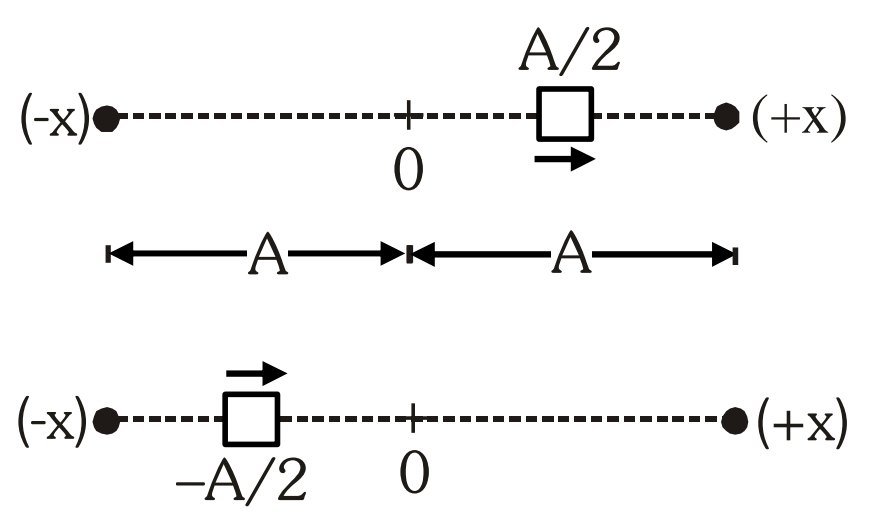
Two bodies performing S.H.M. have same amplitude and frequency. Their phases at a certain instant are as shown in the figure. The phase difference between them is:
Q140.
The period of a particle is 8s. At t = 0 it is at the mean position. The ratio of distance covered by the particle in first second and second will be:
Q141.
A man of mass 60 kg standing on a platform executing S.H.M. in the vertical plane. The displacement from the mean position varies as y = 0.5 sin (2πft). The minimum value of f, for which the man will feel weightlessness at the highest point is: (y is in metres)
Q142.
Two simple harmonic motions are represented by the equations y₁ = 0.1 sin(100πt + π/3) and y₂ = 0.1 cos(100πt). The phase difference of the velocity of particle 1, with respect to the velocity of particle 2 is:
Q143.
A point mass oscillates along the x-axis according to the law x = x₀ cos(ωt - π/4). If the acceleration of the particle is written as a = A cos(ωt + δ), then:
Q144.
The potential energy of a simple harmonic oscillator at mean position is 3 joules. If its mean K.E. is 4 joules, its total energy will be:
Q145.
The total energy of a harmonic oscillator of mass 2kg is 9 joules. If its potential energy at mean position is 5 joules, its K.E. at the mean position will be:
Q146.
A horizontal spring is connected to a mass M. It executes simple harmonic motion. When the mass M passes through its mean position, an object of mass m is put on it and the two move together. The ratio of frequencies before and after will be:
Q147.
Two particles A and B of equal masses are suspended from two massless springs of spring constants k₁ and k₂, respectively. If the maximum velocities during oscillations are equal, the ratio of amplitudes of A and B is: