Q1.
The displacement of a particle executing simple harmonic motion is given by \( y = A_0 + A\sin\omega t + B\cos\omega t \). Then the amplitude of its oscillation is given by
Q2.
The distance covered by a particle undergoing SHM in one time period is (amplitude = A)
Q3.
Out of the following functions representing motion of a particle, which represents SHM?
(1) \( y = \sin\omega t - \cos\omega t \)
(2) \( y = \sin^3\omega t \)
(3) \( y = 5\cos\left(3\omega t - \frac{3\pi}{4}\right) \)
(4) \( y = 1 + \omega t + \omega^2 t^2 \)
Q4.
Two particles are oscillating along two close parallel straight lines side by side, with the same frequency and amplitudes. They pass each other, moving in opposite directions when their displacement is half of the amplitude. The mean positions of the two particles lie on a straight line perpendicular to the paths of the two particles. The phase difference is
Q5.
The displacement of a particle along the x-axis is given by \( x = a\sin^2\omega t \). The motion of the particle corresponds to
Q6.
A particle executes simple harmonic oscillation with an amplitude a. The period of oscillation is T. The minimum time taken by the particle to travel half of the amplitude from the equilibrium position is
Q7.
The circular motion of a particle with constant speed is
Q8.
Two SHM\s with same amplitude and time period, when acting together in perpendicular directions with a phase difference of \( \frac{\pi}{2} \), give rise to
Q9.
A simple harmonic oscillator has an amplitude A and time period T. The time required by it to travel from \( x = A \) to \( x = \frac{A}{2} \) is
Q10.
The composition of two simple harmonic motions of equal periods at right angle to each other and with a phase difference of \( \pi \) results in the displacement of the particle along
Q11.
The radius of circle, the period of revolution, initial position and sense of revolution are indicated in the figure. y-projection of the radius vector of rotating particle P is
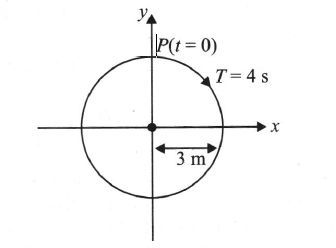
Q12.
The phase difference between displacement and acceleration of a particle in a simple harmonic motion is
Q13.
Average velocity of a particle executing SHM in one complete vibration is
Q14.
A particle executes linear simple harmonic motion with an amplitude of 3 cm. When the particle is at 2 cm from the mean position, the magnitude of its velocity is equal to that of its acceleration. Then its time period in seconds is
Q15.
A particle is executing a simple harmonic motion. Its maximum acceleration is α and maximum velocity is β. Then, its time period of vibration will be
Q16.
A particle is executing SHM along a straight line. Its velocities at distances x₁ and x₂ from the mean position are V₁ and V₂, respectively. Its time period is
Q17.
The oscillation of a body on a smooth horizontal surface is represented by the equation, X = A cos(ωt) where X = displacement at time t, ω = frequency of oscillation. Which one of the following graphs shows correctly the variation of acceleration a with time t?

Q18.
A particle of mass m oscillates along x-axis according to equation x = a sin ωt. The nature of the graph between momentum and displacement of the particle is
Karnataka NEET 2013
medium
Q19.
Two simple harmonic motions of angular frequency 100 and 1000 rad s⁻¹ have the same displacement amplitude. The ratio of their maximum acceleration is
Q20.
A point performs simple harmonic oscillation of period T and the equation of motion is given by x = a sin(ωt + π/6). After the elapse of what fraction of the time period, the velocity of the point will be equal to half of its maximum velocity?
Q21.
The phase difference between the instantaneous velocity and acceleration of a particle executing simple harmonic motion is
Q22.
A particle executing simple harmonic motion of amplitude 5 cm has maximum speed of 31.4 cm/s. The frequency of its oscillation is
Q23.
Which one of the following statements is true for the speed v and the acceleration a of a particle executing simple harmonic motion?
Q24.
A particle starts with S.H.M. from the mean position as shown in the figure. Its amplitude is A and its time period is T. At one time, its speed is half that of the maximum speed. What is its displacement?
Q25.
If a simple harmonic oscillator has got a displacement of 0.02 m and acceleration equal to 2.0 m/s² at any time, the angular frequency of the oscillator is equal to
Q26.
A body is executing simple harmonic motion. When the displacements from the mean position is 4 cm and 5 cm, the corresponding velocities of the body is 10 cm/sec and 8 cm/sec. Then the time period of the body is
Q27.
Which one of the following equations of motion represents simple harmonic motion?
Q28.
A particle executes S.H.M. along x-axis. The force acting on it is given by
Q29.
A particle of mass m is released from rest and follows a parabolic path as shown. Assuming that the displacement of the mass from the origin is small, which graph correctly depicts the position of the particle as a function of time?
Q30.
The particle executing simple harmonic motion has a kinetic energy K₀cos²ωt. The maximum values of the potential energy and the total energy are respectively
Q31.
The potential energy of a simple harmonic oscillator when the particle is half way to its end point is
Q32.
A particle of mass m oscillates with simple harmonic motion between points x₁ and x₂, the equilibrium position being O. Its potential energy is plotted. It will be as given below in the graph
Q33.
Displacement between maximum potential energy position and maximum kinetic energy position for a particle executing simple harmonic motion is
Q34.
The total energy of particle performing SHM depends on
Q35.
A linear harmonic oscillator of force constant 2 × 10⁶ N/m and displacement 0.01 m has a total mechanical energy of 160 J. Its
Q36.
In a simple harmonic motion, when the displacement is one-half the amplitude, what fraction of the total energy is kinetic?
Q37.
A loaded vertical spring executes S.H.M. with a time period of 4 sec. The difference between the kinetic energy and potential energy of this system varies with a period of
Q38.
A spring of force constant k is cut into lengths of ratio 1:2:3. They are connected in series and the new force constant is k′. Then they are connected in parallel and force constant is k″. Then k′:k″ is
Q39.
A body of mass m is attached to the lower end of a spring whose upper end is fixed. The spring has negligible mass. When the mass m is slightly pulled down and released, it oscillates with a time period of 3 s. When the mass m is increased by 1 kg, the time period of oscillations becomes 5 s. The value of m in kg is
Q40.
The period of oscillation of a mass M suspended from a spring of negligible mass is T. If along with it another mass M is also suspended, the period of oscillation will now be
Q41.
A simple pendulum performs simple harmonic motion about x = 0 with an amplitude a and time period T. The speed of the pendulum at x = a/2 will be
Q42.
A mass of 2.0 kg is put on a flat pan attached to a vertical spring fixed on the ground as shown in the figure. The mass of the spring and the pan is negligible. When pressed slightly and released, the mass executes a simple harmonic motion. The spring constant is 200 N/m. What should be the minimum amplitude of the motion so that the mass gets detached from the pan? (take g = 10 m/s²)
Q43.
A rectangular block of mass m and area of cross-section A floats in a liquid of density ρ. If it is given a small vertical displacement from equilibrium it undergoes oscillation with a time period T, then
Q44.
Two springs of spring constant k₁ and k₂ are joined in series. The effective spring constant of the combination is given by
Q45.
The time period of a mass suspended from a spring is T. If the spring is cut into four equal parts and the same mass is suspended from one of the parts, then the new time period will be
Q46.
A mass is suspended separately by two different springs in successive order then time periods is t₁ and t₂ respectively. If it is connected by both spring as shown in figure then time period is t₀, the correct relation is
Q47.
Two masses M_A and M_B are hung from two strings of length l_A and l_B respectively. They are executing SHM with frequency relation f_A = 2f_B, then relation
Q48.
The bob of simple pendulum having length l, is displaced from mean position to an angular position θ with respect to vertical. If it is released, then velocity of bob at equilibrium position
Q49.
Time period of a simple pendulum is 2 sec. If its length is increased by 4 times, then its time period becomes
Q50.
Two simple pendulums of length 5 m and 20 m respectively are given small linear displacement in one direction at the same time. They will again be in the phase when the pendulum of shorter length has completed ______ oscillations.
Q51.
A mass m is vertically suspended from a spring of negligible mass; the system oscillates with a frequency n. What will be the frequency of the system, if a mass 4m is suspended from the same spring?
Q52.
If the length of a simple pendulum is increased by 2%, then the time period
Q53.
A simple pendulum with a bob of mass m oscillates from A to C and back to A such that PB is H. If the acceleration due to gravity is g, then the velocity of the bob as it passes through B is
Q54.
A body of mass 5 kg hangs from a spring and oscillates with a time period of 2π seconds. If the ball is removed, the length of the spring will decrease by
Q55.
A seconds pendulum is mounted in a rocket. Its period of oscillation will decrease when rocket is
Q56.
A simple pendulum is suspended from the roof of a trolley which moves in a horizontal direction with an acceleration a, then the time period is given by T = 2π√(l/a′), where a′ is equal to
Q57.
A mass m is suspended from the two coupled springs connected in series. The force constant for springs are k₁ and k₂. The time period of the suspended mass will be
Q58.
When an oscillator completes 100 oscillations, its amplitude reduced to 1/3 of initial value. What will be its amplitude, when it completes 200 oscillations?
Q59.
In case of a forced vibration, the resonance peak becomes very sharp when the
Q60.
A particle, with restoring force proportional to displacement and resisting force proportional to velocity is subjected to a force Fsinωt. If the amplitude of the particle is maximum for ω = ω₁ and the energy of the particle is maximum for ω = ω₂, then (ω₀ is natural frequency of oscillation of the particle)
Q61.
The phase difference between displacement and acceleration of a particle in a simple harmonic motion is:
Q62.
Identify the function which represents a periodic motion
Q63.
A body is executing simple harmonic motion with frequency 'n', the frequency of its potential energy is:
Q64.
A spring is stretched by 5 cm by a force 10 N. The time period of the oscillations when a mass of 2 kg is suspended by it is:
Q65.
A mass m is vertically suspended from a spring of negligible mass, the system oscillates with a frequency f. Now spring is cut into two equal parts, these parts are connected in parallel and a mass 4m is suspended, the new frequency of oscillation will be
Q66.
Two pendulums of length 121 cm and 100 cm start vibrating in phase. At some instant, the two are at their mean position in the same phase. The minimum number of vibrations of the shorter pendulum after which the two are again in phase at the mean position is:
Q67.
During simple harmonic motion of a body, the energy at the extreme positions is:
Q68.
Identify the function which represents a non-periodic motion.
Q69.
Match List - I with List - II :
List - I (x-y graphs)
List - II (Situations)
(a) (i) Total mechanical energy is conserved
(b) (ii) Bob of a pendulum is oscillating under negligible air friction
(c) (iii) Restoring force of a spring
(d) (iv) Bob of a pendulum is oscillating along with air friction
Choose the correct answer from the options given below:
Q70.
If x = 5 sin(πt + π/3) m represents the motion of a particle executing simple harmonic motion, the amplitude and time period of motion respectively, are:
Q71.
The phase difference between displacement and acceleration of a particle in a simple harmonic motion is:
Q72.
A particle executing simple harmonic motion with amplitude 'a' has the same potential and kinetic energies at the displacement:
Q73.
A body is executing simple harmonic motion with frequency 'n', the frequency of its potential energy is:
Q74.
If the mass of the bob in a simple pendulum is increased to thrice its original mass and its length is made half its original length, then the new time period of oscillation is x times its original time period. Then the value of x is: