Q1.
A particle moves 21 m along the vector \( 6\hat{i} + 2\hat{j} + 3\hat{k} \), then 14 m along the vector \( 3\hat{i} - 2\hat{j} + 6\hat{k} \). Its total displacement (in meters) is
Q2.
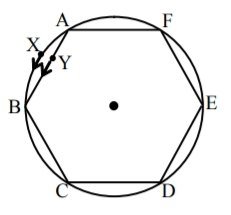
Two particles X and Y are respectively moving on the circular path and regular hexagon as shown. O is centre of circle and hexagon both. When both X and Y have moved from point A to point D, the ratio of distance moved by X to magnitude of displacement of Y is -
Q3.
A blind person after walking 10 steps in one direction, each of length 80 cm, turns randomly to the left or to the right by 90°. After walking a total of 40 steps the maximum possible displacement of the person from his starting position could be:
Q4.
A particle moves 4√2 m in South-West direction, 12m in upward direction and then 1m in East direction. Find the net displacement.
Q5.
Consider East as +ve x axis, North as +ve y-axis. A girl walks 10 m East first time then 10 m in a direction 30° West of North for the 2nd time & then third time in unknown direction and magnitude, so as to return to her initial position. What is her third displacement vector:
Q6.
Two particles positioned at A(5, 3) and B(7, 3) are moving with constant velocity \( 2\hat{i} + 3\hat{j} \) and \( x\hat{i} + y\hat{j} \) respectively. After 2 s they collide, then the values of x and y are respectively:
Q7.
For a right handed coordinate system, positive x-axis is towards right of you and positive z-axis is upward then positive y-axis will be:
Q8.
Particle moves in straight line with constant velocity of 10 m/s for 5 sec, then with constant retardation of 10 m/s². Find its total displacement before coming to rest:
Q9.
A man starts from his house with uniform speed. After taking a few turns, he reaches his house. There are two ways to reach house : (A) Take left turn after 4 min, again left turn after 3 min, again left turn after 6 min, one more left turn after 3 min, finally move 2 min to reach house. (B) Take right turn after 3 min, left turn after 2 min, right turn after 3 min, again right turn after 1 min, again right turn after 6 min. Finally move 3 min to reach house. All turns are at 90°. Which of the following is correct:
Q10.
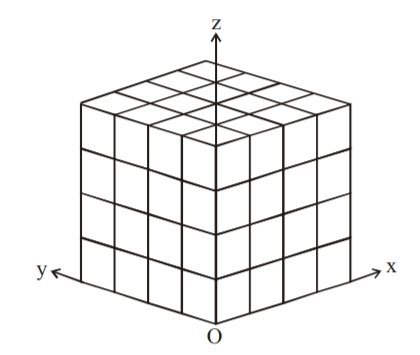
A child starts at one corner of a cubical jungle gym in a playground and climbs up to the diagonally opposite corner. The original corner (O) is the coordinate origin, and the x, y and z-axes are oriented along the jungle gym edges. The length of each side is 2 m. The child's displacement is:
Q11.
A particle is moving towards East with velocity \( 10 \, \text{ms}^{-1} \) and acceleration \( 5 \, \text{ms}^{-2} \) directed towards West. Find the distance travelled in 8 seconds.
Q12.
The hour hand of a clock is 6 cm long. The magnitude of the displacement of the tip of hour hand between 1:00 pm to 9:00 pm is:
Q13.
Position of a particle at t = 0 is (2,3,0). It starts moving with a speed of 10 m/sec in direction 37° north of west. Its position after t = 1 sec is - (Take north as positive y axis and east as positive x axis)
Q14.
A body travelling along a straight line with a uniform acceleration has velocities 5 m/s at a point A and 15 m/s at a point B respectively. If M is the mid point of AB, then choose incorrect statement.
Q15.
A motor cyclist accelerates from rest with acceleration of \( 2 \, \text{m/s}^2 \) for a time of 10 sec. Then he moves with a constant velocity for 20 sec and then finally comes to rest with an deceleration of \( 1 \, \text{m/s}^2 \). Average speed for complete journey is :-
Q16.
A particle travels with speed 100 m/s from the point (10, 20) in a direction \( 24\hat{i} + 7\hat{j} \). Find its position vector after 2 seconds.
Q17.
A car goes A to B along the path with constant acceleration "a" as shown in figure. Student-1 infers that initial velocity is positive, acceleration is negative and displacement is positive. Student-2 infers that initial velocity is negative, acceleration is positive and displacement is positive.

Q18.
A particle moves with a speed v in a horizontal circular path. The change in its velocity for covering \( 60^\circ \) will be:
Q19.
At time t = 0 s a car passes a point with velocity of 16 m/s and thereafter slows down with acceleration \( a = -0.5t \, \text{m/s}^2 \), where t is in seconds. It stops at the instant t =
Q20.
Which of the following must be true for magnitude of average velocity of a body if \( v_1 \) and \( v_2 \) are magnitude of average speeds during successive time intervals \( t_1 \) and \( t_2 \) in which body covers distances \( d_1 \) and \( d_2 \) and displacements \( \vec{s_1} \) and \( \vec{s_2} \)?
Q21.
A particle is moving on a straight line with constant retardation of \( 1 \, \text{m/s}^2 \). What is the average speed of the particle in the last two meters before it stops (in m/s)?
Q22.
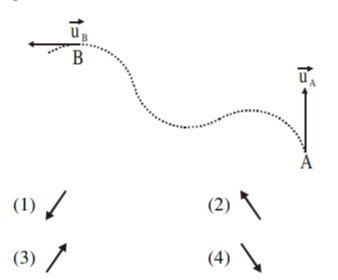
In the figure, path of a particle is shown. Its velocity is shown at points A & B. Which of the following vector correctly represents the average acceleration during its motion from point A to B.
Q23.
Mark the INCORRECT statement for a particle moving on a straight line:
Q24.
Two particles having position vectors (at t = 0) \( \vec{r_1} = (3\hat{i} + 5\hat{j}) \) metres and \( \vec{r_2} = (-3\hat{i} - \hat{j}) \) metres are moving with constant velocities \( \vec{v_1} = (4\hat{i} + 3\hat{j}) \) m/s and \( \vec{v_2} = (7\hat{i} + \alpha\hat{j}) \) m/s respectively. If they collide after 2 seconds, then the value of \( \alpha \) is
Q25.
A large procession of people is moving along a road of width 10 m. The number of people present per square meter of the road is 6 (on an average). The average speed at which the procession is moving is 0.15 m/s. Find the number of people crossing the railway track per second.
Q26.
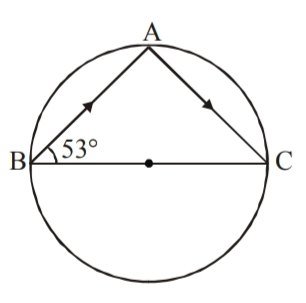
BC is the diameter of a circle of radius 62.5 cm. A particle moves with constant speed of 2.5 cm/s from B to C through A. Find time taken.
Q27.
The slope of velocity position graph of a particle moving along a straight line is 15 units where velocity is also 15 units. The acceleration of particle at that position is:
Q28.
Which of the following is(are) example(s) of zero vector? (A)The displacement vector of a stationary object. (B) The velocity vector of a stationary object. (C) The position vector of the origin of coordinate axes. (D)The acceleration vector of an object moving with uniform velocity.
Q29.
Find out the length of train which is moving with constant velocity. Information I : Train crosses a pole in 5 sec. Information II : It cross the bridge of length 500 m in 8 seconds.
Q30.
Some informations are given for a body moving in a straight line. The body starts its motion at t=0. Information I : The velocity of a body at the end of 4s is 16 m/s Information II : The velocity of a body at the end of 12s is 48 m/s Information III : The velocity of a body at the end of 22s is 88 m/s The body is certainly moving with
Q31.
A particle moves half the time of its journey with velocity u. The rest of the half time it moves with two velocities \( v_1 \) and \( v_2 \) such that half the distance it covers with \( v_1 \) and the other half with \( v_2 \). Find the net average velocity assume straight line motion:
Q32.
A particle is moving on a straight line represented by x-axis. When its velocity (v) and position coordinate (x) have opposite signs
Q33.
A bee sets out of its beehive, flies \( 15\sqrt{3} \) m in the east, turns down, descends 12 m flying vertically downwards, then turns in the south, flies 9 m and finally reaches a flower 5 s after its sets out off its beehive. What is magnitude of average velocity vector?
Q34.
In one second a particle moves with constant speed from point A to point B along the circular track of radius 1.0 m as shown in the figure. What is the average acceleration of the particle during this motion.
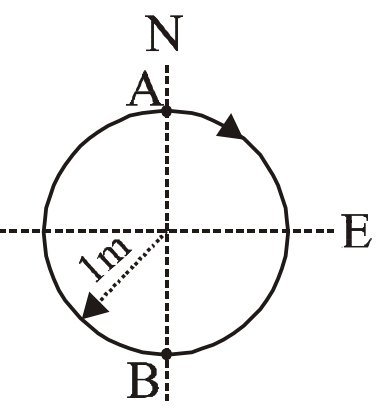
Q35.
A car moves with a speed of 60 km/hr from point A to point B and then with the speed of 40 km/hr from point B to point C. Further it moves to a point D with a speed equal to its average speed between A and C. Points A, B, C and D are collinear and equidistant. The average speed of the car between A and D is:
Q36.
The force will cause the particle to
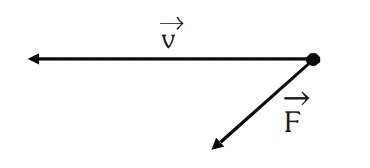
Q37.
A bead is falling in medium 1 with a uniform speed of 3 m/s for 2 s. Then it enters into air and falls freely under gravity for 2 m. Finally, it enters medium 2 and immediately moves with uniform speed for 3 s. Find the total distance the bead has traveled. (\( g = 10 \, \text{m/s}^2 \))
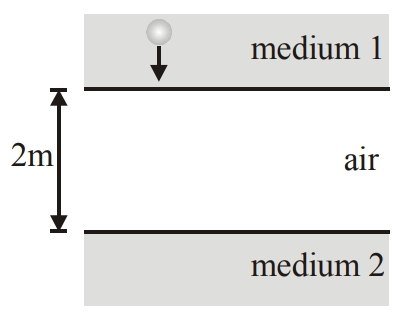
Q38.
Two particles are projected simultaneously with different speed from the same point as shown in figure. Select incorrect statement:
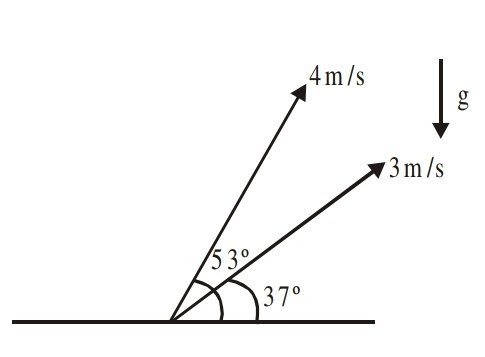
Q39.
A car covers a distance of 2 km in 2.5 minutes. If it covers half of the distance with speed 40 km/hr, then the rest distance it shall cover with a speed of:
Q40.
A boy starts towards east with uniform speed 5 m/s. After t = 2 sec, he turns right and travels 40 m with same speed. Again he turns right and travel for 8 sec with same speed. His average velocity is:
Q41.
Which of the following is correct:
Q42.
A man moves on his motorbike with 54 km/hr and takes a U-turn (180°) and continues to move with same speed. The time for U-turn is 10 sec. Find the average acceleration during U-turn.
Q43.
A man starts from his home at 10:00 a.m., walks with a speed of 10 km/h on a straight road upto market 20 km away, stays at the market till 2 p.m. and returns home by an auto with speed of 20 km/h. Average speed over this interval (from home till returning back to home) is:
Q44.
Which of the following relation is not true:
Q45.
A particle moves with constant acceleration along a straight line starting from rest. The percentage increase in its displacement during the 4th second compared to its displacement in the 3rd second is
Q46.
The engine of a vehicle can produce a maximum acceleration of 4 m/s². Its brakes can produce a maximum retardation of 6 m/s². The minimum time in which it can cover a distance of 3 km is
Q47.
A motor cyclist accelerates from rest with acceleration of 2 m/s² for a time of 10 sec. Then he moves with a constant velocity for 20 sec and then finally comes to rest with an deceleration of 1 m/s². Average speed for complete journey is:
Q48.
A car has constant acceleration of 1 m/s², constant retardation of 2 m/s² and it goes to a maximum speed of 20 m/s. The minimum amount of time it would take to drive this car starting from rest and finishing at rest is
Q49.
A boy drops a ball from the top of a tower of height 22.5 m and at the same instant another boy throws a ball upwards from the foot of the tower. From a window at the middle height of the tower a third boy observes the balls collide with each other in front of him. What should be the velocity of projection of the lower ball?
Q50.
A driver applies the brakes on seeing traffic signal 400 m ahead. At the time of applying the brakes, vehicle was moving with 15 m/s and afterwards it starts retarding with 0.3 m/s². The distance of vehicle after 1 min, from the traffic light is
Q51.
The greatest acceleration or deceleration that a train may have is a. The minimum time in which the train may reach from one station to the other separated by a distance d is:
Q52.
An object starts from rest with constant acceleration. In which second it will travel same distance as much it travels in first five seconds:
Q53.
A particle moves through the origin of an x-y coordinate system at t = 0 with initial velocity \( \vec{u} = (4\hat{i} - 5\hat{j}) \) m/s. It moves in x-y plane with an acceleration \( \vec{a} = 2\hat{i} \) m/s². Speed of the particle at t = 4 second is:
Q54.
A car moving on a straight road with speed 144 km/hr is brought to stop within a distance of 100 m. How long does it take to stop (assuming uniform retardation) and if the speed of car is doubled, then stopping distance will become respectively:
Q55.
The motion of a particle is defined by the position vector \( \vec{r} = (\cos t)\hat{i} + (\sin t)\hat{j} \) where t is expressed in seconds. Determine the value of t for which positions vectors and velocity vector are perpendicular.
Q56.
Velocity (in m/s) of a particle moving in a straight line is given by \( V = t^2 - 2t + 1 \):
List-I
(P) Velocity of particle at t = 3 sec is
(Q) Acceleration of particle at t = 2 is
(R) Time when particle is at rest is
(S) Magnitude of average acceleration of particle in first one second is
List-II
(1) 1
(2) 2
(3) 3
(4) 4
Q57.
The height (in meters) at any time t (in seconds) of a ball thrown vertically varies according to equation \( h(t) = -12t^2 + 144t \). After what time the ball reaches the highest point?
Q58.
The acceleration of a particle (in m/s²) is given by \( a(t) = 6t^2 \). Given that v(0) = 4 m/s, what is the velocity of the particle at t = 3 s?
Q59.
The position vector of a car w.r.t. its starting point is given as \( \vec{r} = at\hat{i} - bt^2\hat{j} \) where a and b are positive constants. The locus of the particle is:
Q60.
The velocity \( \frac{d\vec{r}}{dt} \) at t = 0 is:
Q61.
Initial acceleration \( \frac{d^2\vec{r}}{dt^2} \) of particle is:
Q62.
If velocity of particle moving along x-axis is given as \( v = k\sqrt{x} \). Then (a is acceleration):
Q63.
The co-ordinates of a particle in x-y plane are given as x = 2t² + t and y = 16t² + 8t. The motion of the particle is:
Q64.
The relation between time t and distance x is given by t = Ax² + Bx, where A and B are constants. Then the
(A) velocity is given by v = 2Ax + B
(B) velocity is given by v = (2Ax + B)–1
(C) retardation is given by 2Av³
(D) retardation is given by 2Bv³
Q65.
A point moves such that its position as a function of time is given by x² = t² + 1. Its acceleration at time t is
Q66.
The path of a ground to ground projectile near earth surface is represented by y = ax - bx². Acceleration due to gravity is represented by g
List I
(P) Horizontal range
(Q) Tangent of angle of projection
(R) Speed at highest point
(S) Maximum height
List II
(1) g/2b
(2) a²/4b
(3) a/b
(4) a
Q67.
If position of particle is given by x = t³ - 3t² - 30 then speed of particle when its acceleration is zero is : (Here x is in meters and t is in second)
Q68.
Co-ordinate of moving particle at any time t are given by x = 2t², y = (5/2)t². Here x and y are in meters and t is in seconds. Its speed at t = 1 sec is:
Q69.
The position of an object moving along x-axis is given by x = a + bt + ct² where a = 2m, b = 5m/s and c = 4 m/s². The average velocity between t = 1sec and t = 3sec is:
Q70.
Position vector of a particle is given as \( \vec{r}(t) = (4t² - 6)\hat{i} + t²\hat{j} \). The time after which, the velocity vector and acceleration vector becomes perpendicular to each other is equal to -
Q71.
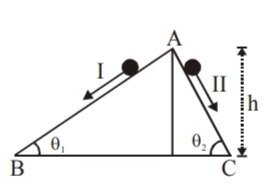
Two inclined frictionless tracks, one gradual and the other steep meet at A from where two stones are allowed to slide down from rest, one on each track as shown in figure. Which of the following statement is correct?
Q72.
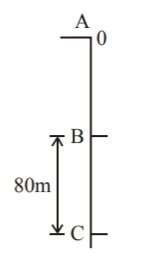
A ball is released from point A. During its motion ball takes two seconds from B to C. Find the time taken by ball from A to C.
Q73.
A man on a moving cart, facing the direction of motion, throws a ball straight up with respect to himself -
Q74.
A person throws balls into air vertically upwards at regular intervals of time of one second. The next ball is thrown when the velocity of the ball thrown earlier becomes zero. The height to which the balls rise is : (Assume, g = 10 m/s²)
Q75.
A body is thrown up vertically with 100 m/s. It travels a distance 5 m in last second of its journey while going up, (before coming to rest momentarily). If it is thrown up by 500 m/s, how much distance it travels in last second of journey while going up.
Q76.
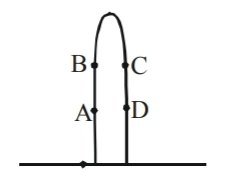
The path of a projectile thrown vertically upwards is as shown. Select incorrect statement:
Q77.
A particle is thrown upward from ground. It experiences a constant resistive force, which produces retardation of 2 m/s². The ratio of time of ascent to the time of descent is:
Q78.
From the top of a tower two stones, whose masses are in the ratio 1 : 2 are thrown; one straight up with an initial speed u and the second straight down with the same speed u. Then, neglecting air resistance :
Q79.
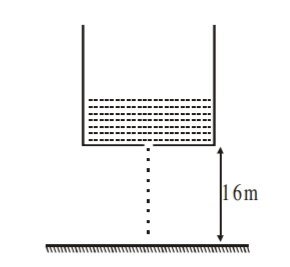
Water drops fall with negligible velocity at regular intervals from a hole at the bottom of a vessel placed 16 m from the ground. The ninth drop is about to fall when the first drop just falls on the floor. Find the distance between the third and fifth drop at this instant in meters.
Q80.
Two identical metal spheres are held above the ground as shown. The separation between them is small compared to their distance above the ground. Both the spheres are released simultaneously. If effects of air drag is negligible, the separation of the spheres before any one of them hits the ground will

Q81.
A particle projected vertically upwards with a velocity u from a point O. When it returns to the point of projection :
Q82.
A boy is standing on a lift moving up with uniform speed of 9.8 m/s. He throws a ball up with speed of 98 m/s w.r.t. lift. Assuming the lift to be opened from up, find the time taken by ball to return to his hands.
Q83.
A player throws a ball vertically upwards. If it returns back in his hands after 20 s, then find the max. height attained by the ball.
Q84.
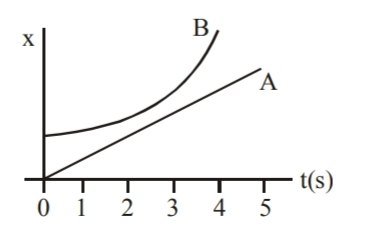
In the figure shown below, the position versus time graph of two particles A and B is shown. Select the correct statement :
Q85.
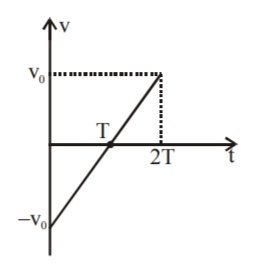
Figure shows the velocity (v) of particle plotted against time 't':
(A)Particle changes its direction of motion at some point
(B) Acceleration of particle remains constant and positive
(C) Speed of particle is always increasing
(D)Velocity of particle first decreases and then increases
(E) Displacement of particle is zero
(F) Speed of particle is first decreases and then increases
(G)Velocity of particle is always increasing
Choose correct statement(s) :-
Q86.
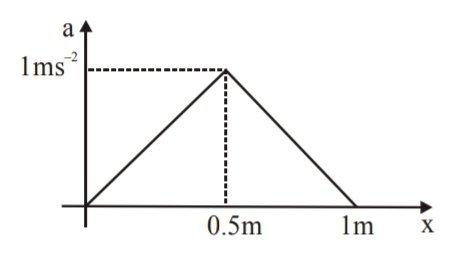
A body initially at rest, starts moving along x-axis in such a way so that its acceleration vs displacement plot is as shown in figure. The maximum velocity of particle is :-
Q87.
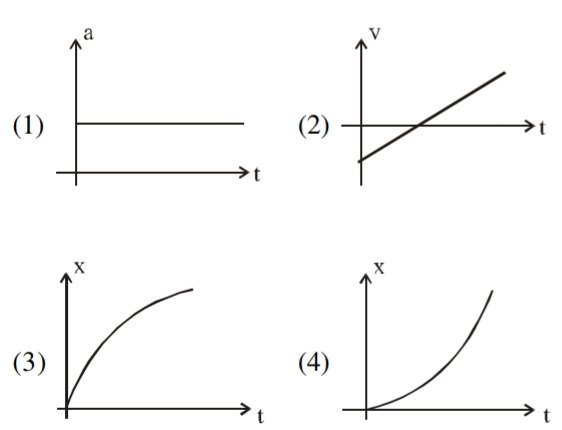
For a particle moving along x-axis, speed must be increasing for the following graph :
Q88.
Position-time graph is given find average speed in time t = 0 and t = 15 sec is :-
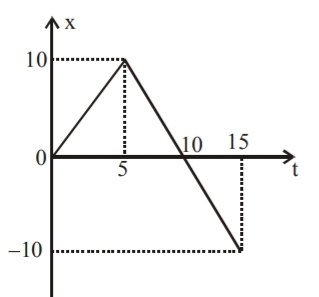
Q89.
Which of the following pairs of graphs does not represent the motion of the same particle in the same interval (curves are parabolic):-
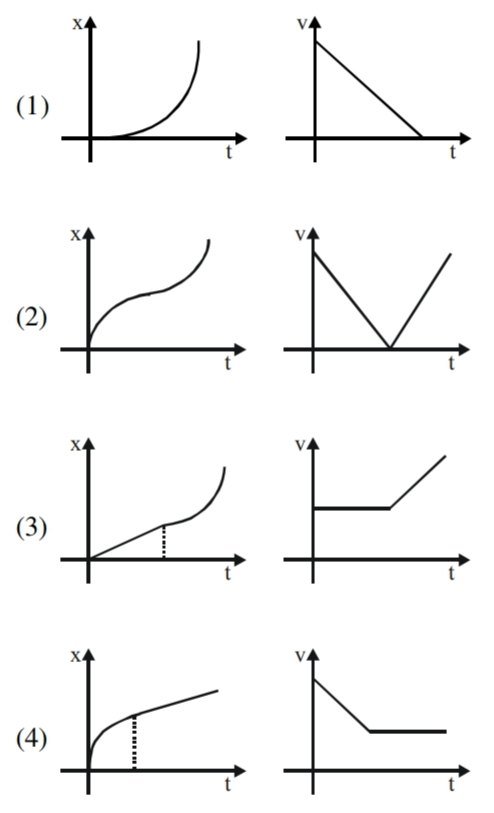
Q90.
In which of the graphs the particle moving on straight line is speeding up?
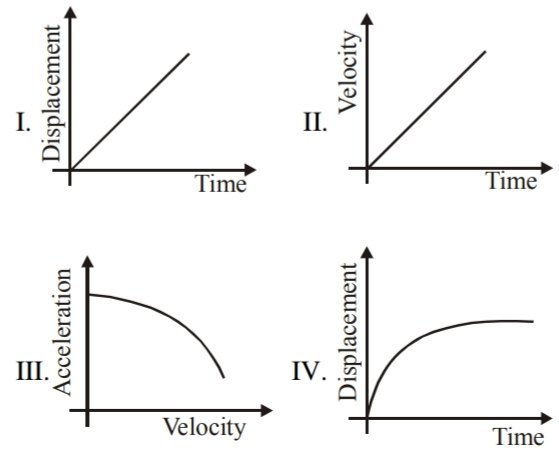
Q91.
Velocity time graph of a particle starting from origin is given below. Choose the CORRECT option for corresponding acceleration and displacement graphs :-
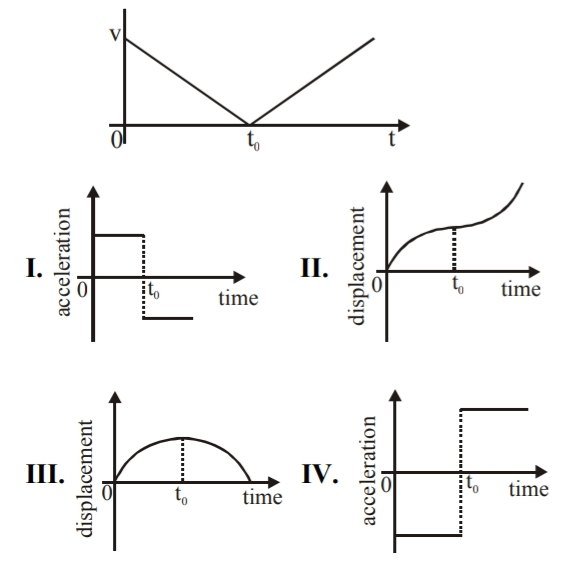
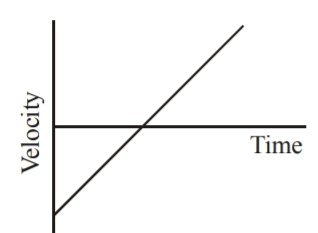
Q92.
The graph below shows the velocity with respect to time of an object moving in a straight line. The positive direction is to the right and the negative direction is to the left. Which of the following statements best describes the motion of this object?
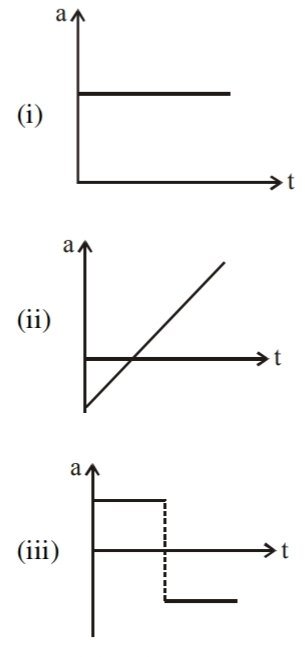
Q93.
A particle (initially in motion) is subjected to different accelerations separately. These acceleration vary with time as shown. In which of these case(s) particle will definitely return to its initial position.
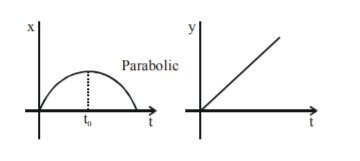
Q94.
An object is moving in x-y plane and its position-time graphs are given. Select the correct statement:-
Q95.
A particle moving along x-axis, its velocity at time t is 'v' then its "v²–t" graph is shown below. Its acceleration at t = 1sec is :-
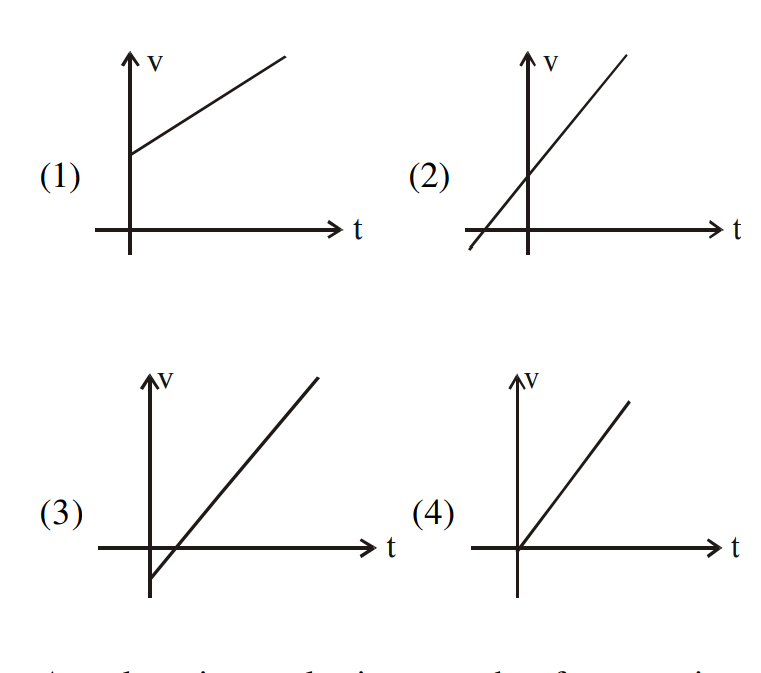
Q96.
The position time relation of a particle moving along the x-axis is given by x = 6 – 2t + 3t² then for velocity time graph
Q97.
Acceleration-velocity graph of a moving particle is shown in figure. The particle is :-
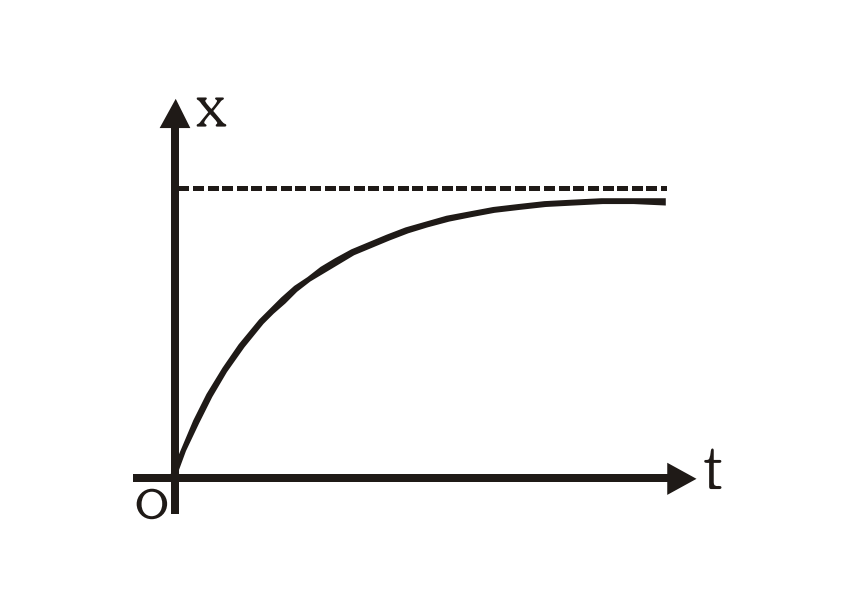
Q98.
The graph shows the displacement of a body as a function of time.
(A)The graph represents motion with constant velocity.
(B) The graph represents accelerated motion
(C) The body comes to rest after a long time.
(D)The graph represents a retarded motion.
Which of the following is/are the conclusion/s?
Q99.
Figure shows the velocity (v) of particle plotted against time 't':
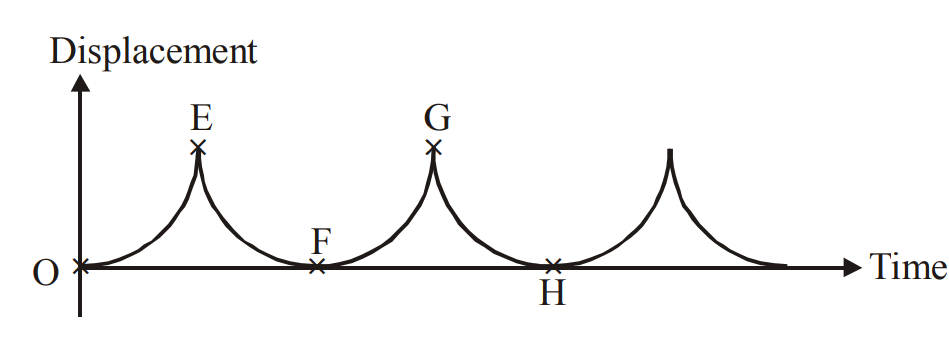
Q100.
The following is a displacement-time graph of a ping-pong ball that is released from a height with zero initial speed. The ping-pong ball bounces for several times. Neglecting the air resistance, which point in the graph represents the second bounce?
Q101.
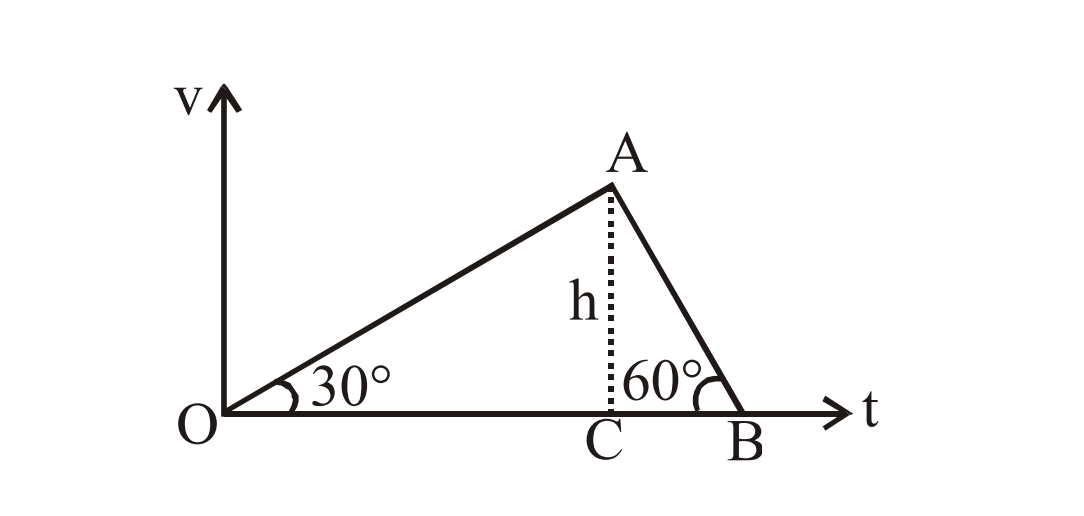
The velocity time (v – t) graph of a body is shown in figure. For the intervals OC & CB, the ratio of the distances covered is :-
Q102.
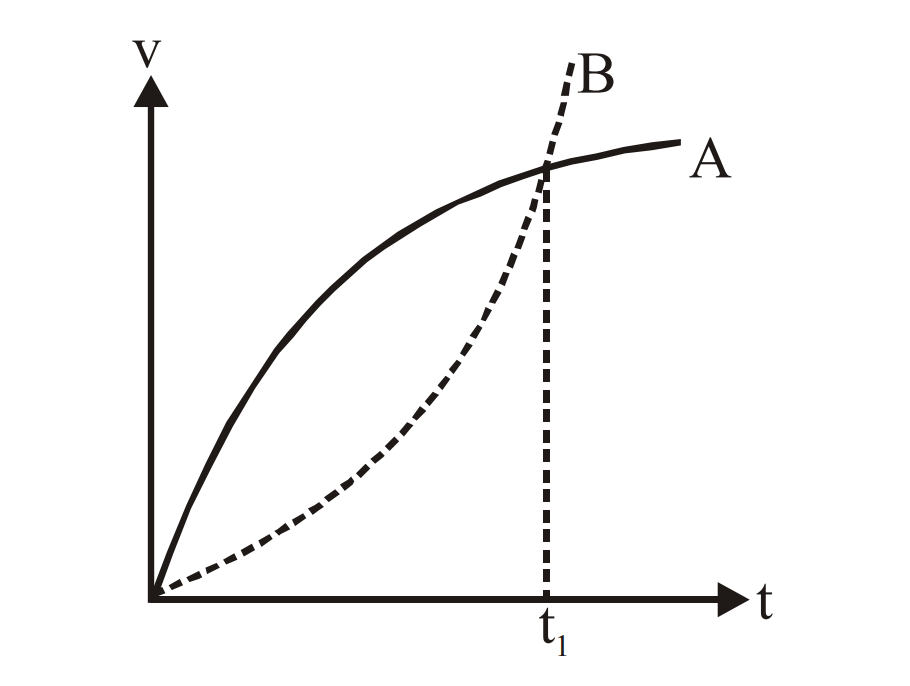
At t = 0, two trucks A and B were at same point on the road. At t = t₁, (motion of trucks A and B is represented by bold and dotted lines respectively):-
Q103.
Average velocity of the particle in time t = 0 to t = 5 s is :-
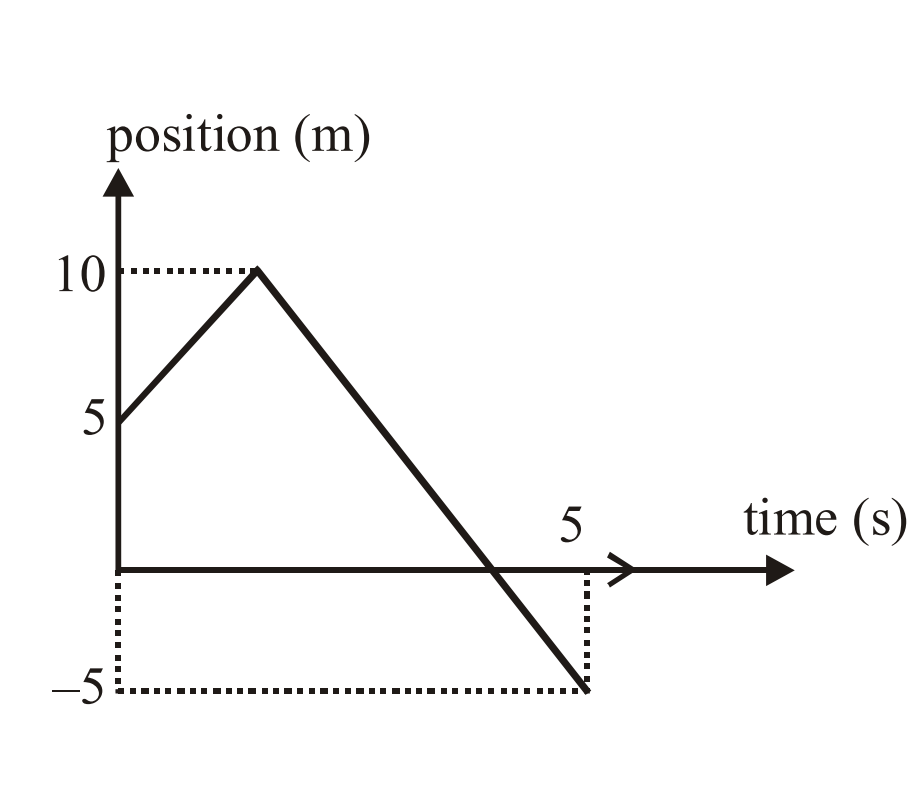
Q104.
Which of the following graphs cannot possibly represent one dimensional motion of a particle :-
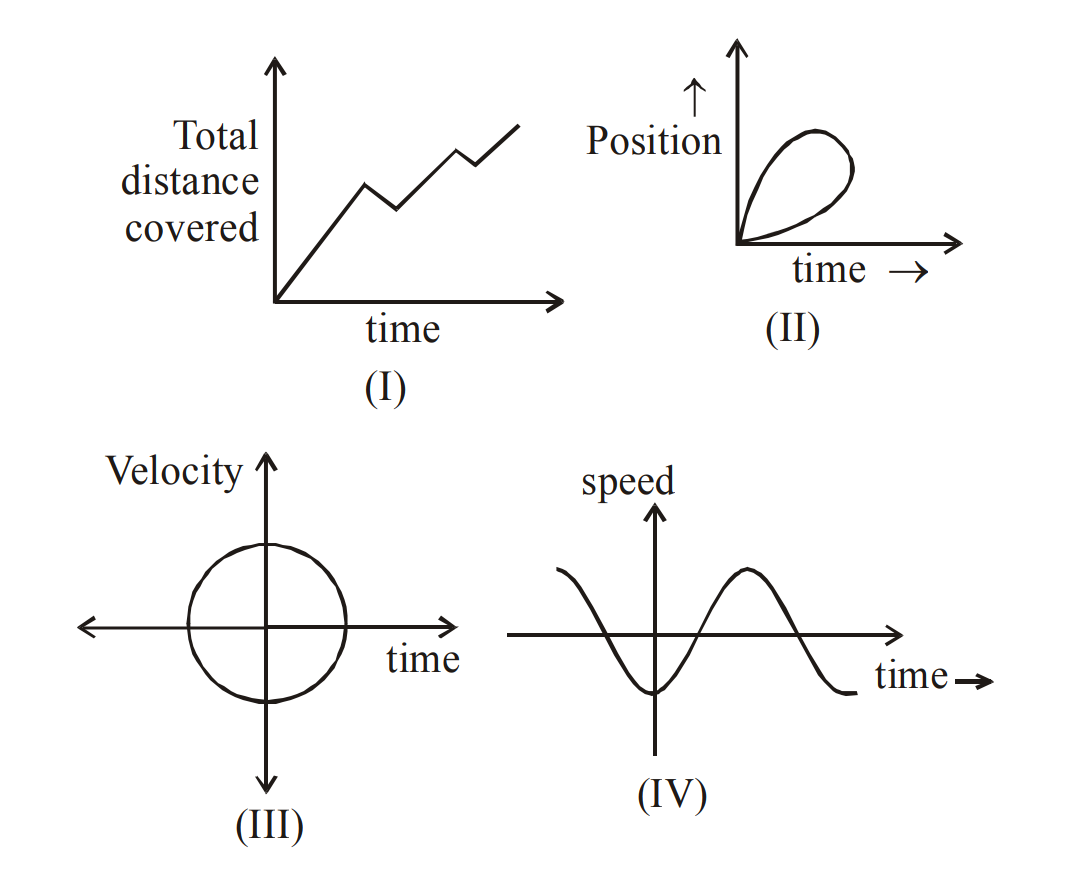
Q105.
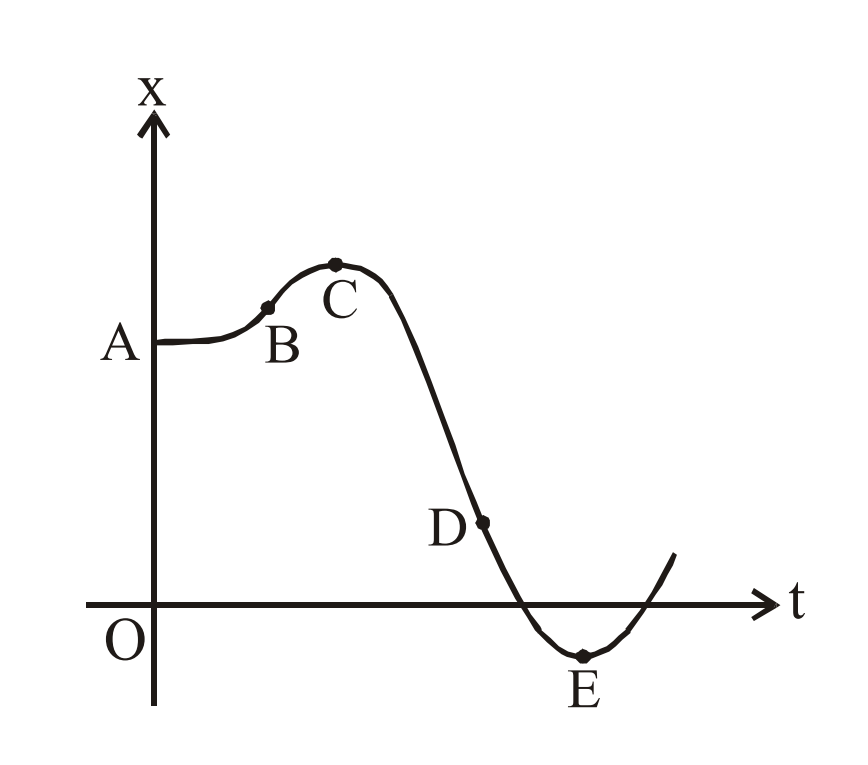
For the position (x)–time (t) graph shown of a particle in one-dimensional motion. Choose the correct alternatives from below :-
(a) Particle was released from rest at t = 0
(b) At C particle will reverse its direction of motion
(c) Average velocity for motion between B and D is positive
(d) At E, velocity = 0 and acceleration > 0
Q106.
For which of the following graphs the average velocity of a particle moving along a straight line for time interval 0 to t must be negative :-
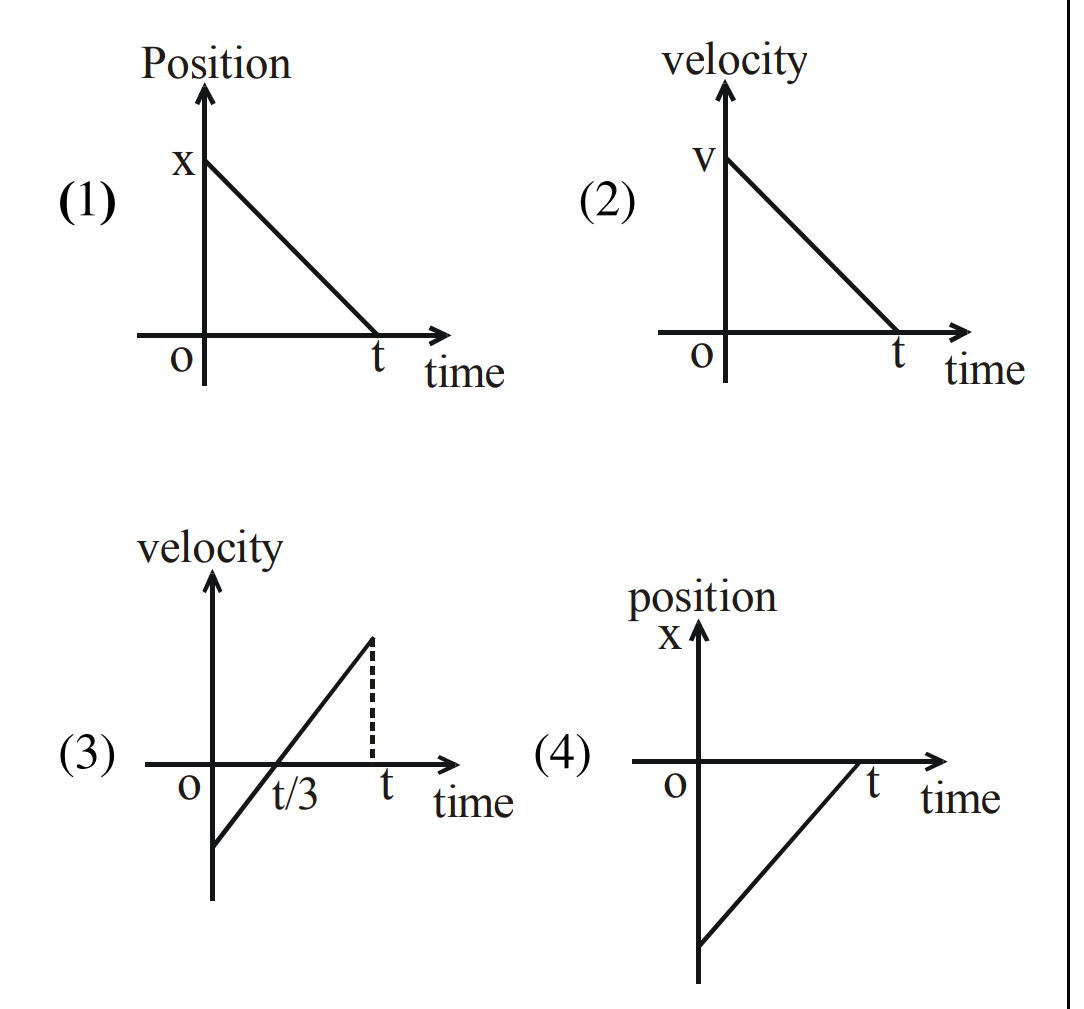
Q107.
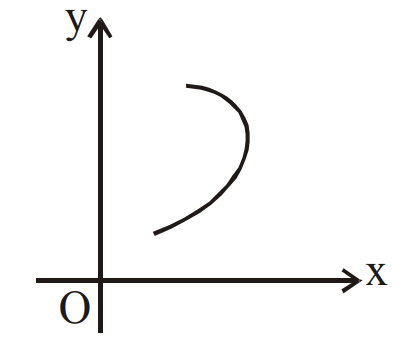
If the given graph is possible in realistic situations, then y and x variables may represent, respectively:
Q108.
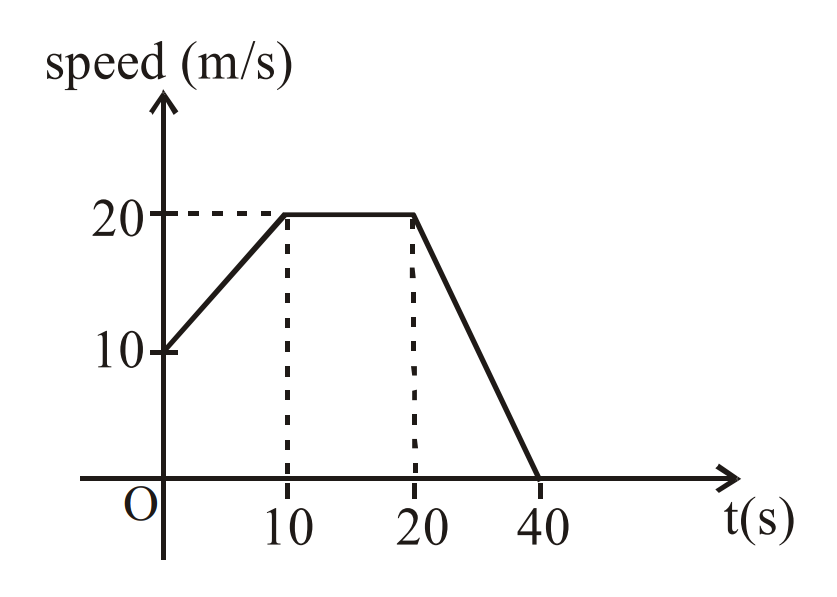
For the given speed-time graph find distance travelled during the interval t = 2 to 25 sec.
Q109.
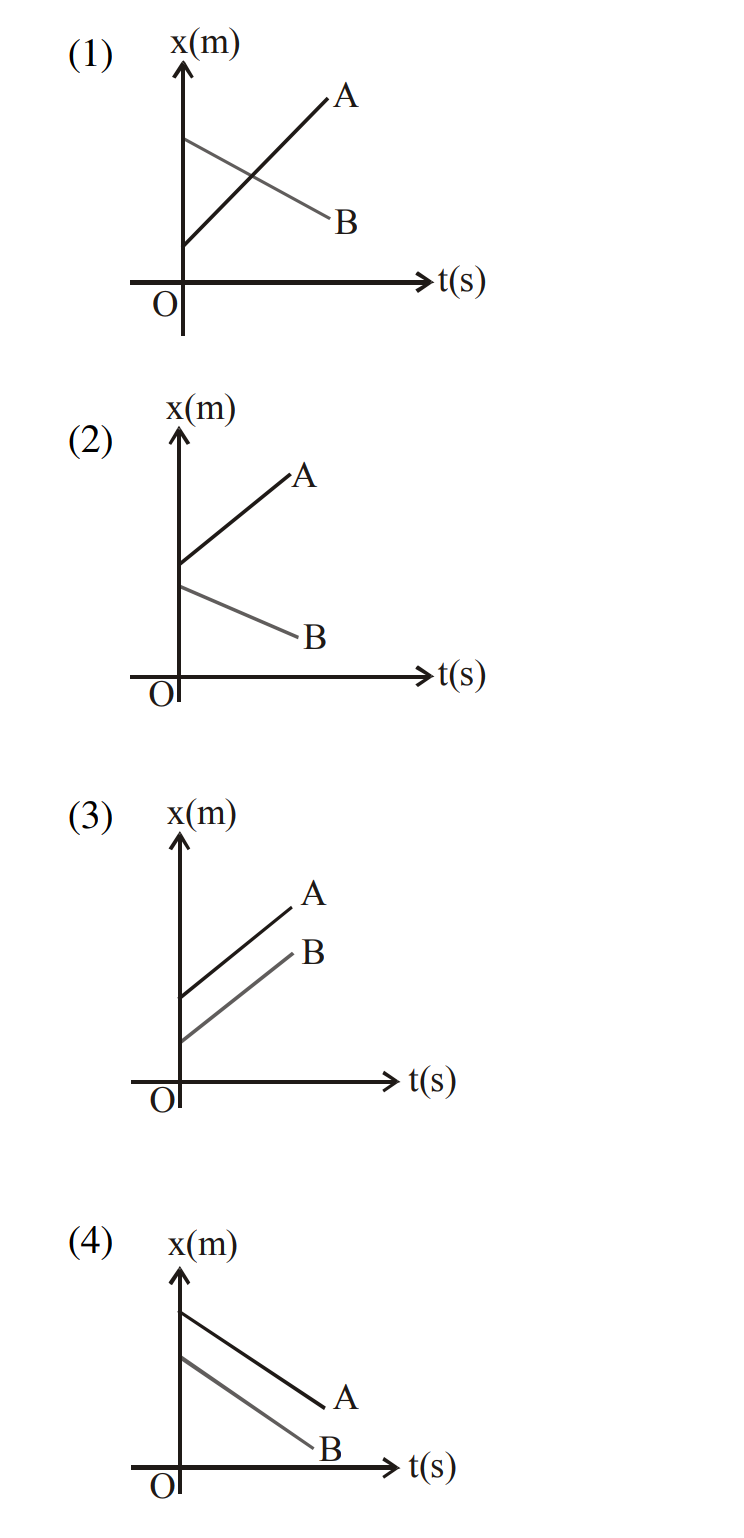
Which of the following position-time graphs represent two object having velocities in opposite directions and not meeting ever.
Q110.
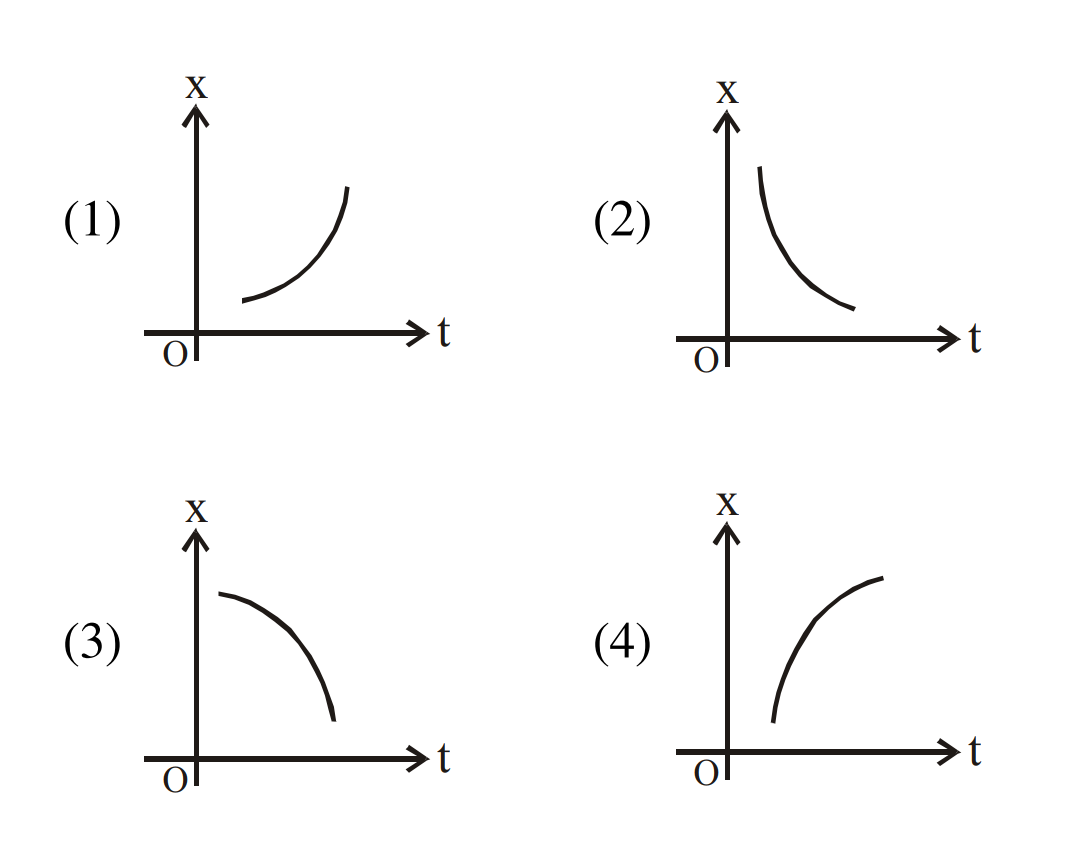
Which of the following position-time graph represents positive acceleration with slowing down:
Q111.
Two trains one of length l₁ = 630 m and other of length l₂ = 120 m move uniformly in two parallel paths in opposite direction with speed u₁ = 48 km/h and u₂ = 102 km/h respectively.
Q112.
A man in a boat crosses a river from point A. If he rows perpendicular to the banks then, 10 minutes after he starts, he will reach point C lying at a distance S = 120 m downstream from point B. If the man heads at a certain angle α to the straight line AB (AB is perpendicular to the banks) against the current he will reach point B after 12.5 minutes. Assume the speed of the boat relative to the water to be constant and of the same magnitude in both cases. Width of the river l is -
Q113.
Velocity of the boat v relative to the water is-
Q114.
Speed of the current u is -
Q115.
The distance between them at time t is :-
Q116.
The distance between them will be shortest at t = ...
Q117.
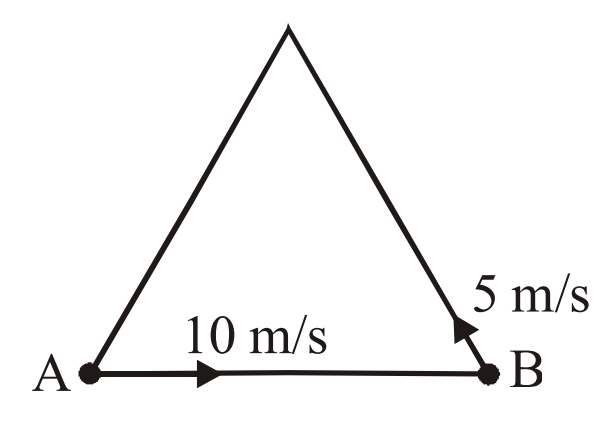
Two boys A & B are standing at the corners of equilateral triangle of side 5 m. They start moving along the sides with constant speed as shown. The time at which they meet for 2nd time is :-
Q118.
If a ball is projected vertical upward from ground such that total distance traveled is 3.6 times of distance travel by the ball in 1st second. Then find time of flight of ball ?
Q119.
A lift is moving with a uniform downward acceleration of 2 m/s². A ball is dropped from a height 2 m from the floor of lift. Find the time taken after which ball will strike the floor (in s) :-
Q120.
Rain is falling with a velocity \( (-4\hat{i} + 8\hat{j} - 10\hat{k}) \) m/s. A person is moving with a velocity of \( (6\hat{i} + 8\hat{j}) \) m/s on the ground. The speed with which the rain drops hit the person is :-
Q121.
A projectile is given an initial velocity of \( (\hat{i} + 2\hat{j}) \) m/s. The equation of its path is : (g = 10 m/s²) :-
Q122.
A particle is thrown in vertical plane with initial speed 10 m/s and angle of projection with horizontal is 30°. At maximum height its speed suddenly becomes zero. Find the time of complete journey.
Q123.
Particle is projected with a velocity of \( (10\hat{i} + 12\hat{j}) \) m/s. If it has a constant acceleration of \( (3\hat{i} - 3\hat{j}) \) m/s². Then select the correct statement:
Q124.
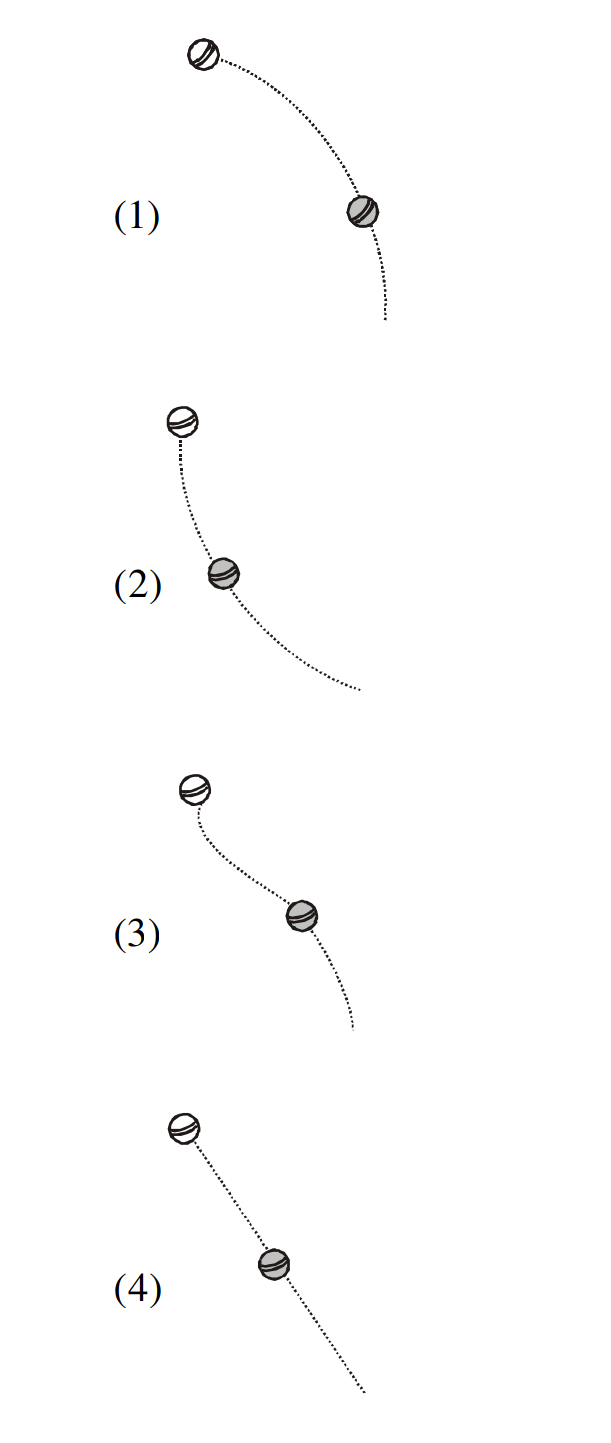
A ball is dropped from a height and falls due to gravity and wind simultaneously imparts it a uniform horizontal acceleration. Which one of the following figures best represents its path?
Q125.
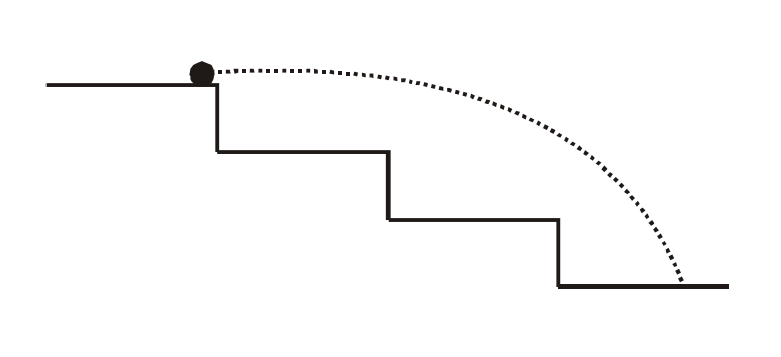
A staircase contains three steps each of 10 cm high and 20 cm wide (figure). What should be the minimum horizontal velocity of a ball rolling off the uppermost plane so as to hit directly the lowest plane :
Q126.
Particle is projected upward with velocity 100 m/s at an angle of 30° with horizontal. Find the time when its velocity is perpendicular to the acceleration :-
Q127.
If the velocity of projection is increased by 1% (other things remains constant) the horizontal range will increase by