Q1.
The ratio of the diameters of two metallic rods of the same material is 2:1 and their lengths are in the ratio 1:4. If the temperature difference between them are equal, the rate of flow of heat in them will be in the ratio of
Q2.
Mud houses are cooler in summer and warmer in winter because
Q3.
Two walls of thicknesses d1 and d2 and thermal conductivity K1 and K2 are in contact. In the steady state, if the temperatures at the outer surface are T1 and T2, the temperature at the common wall is
Q4.
In which of the following phenomenon heat convection does not take place
Q5.
In natural convection, a heated portion of a liquid moves because:
Q6.
It is hotter at the same distance over the top of a fire than it is in the side of it, mainly because
Q7.
The ratio of coefficient of thermal conductivity of two different materials is 5:3. If the thermal resistance of rods of same area of these material is same, then what is ratio of length of these rods?
Q8.
Rate of heat flow through a cylindrical rod is Q1. Temperatures of ends of rod are T1 and T2. If all the linear dimensions of the rod become double and temperature difference remains same, its rate of heat flow is Q2, then:
Q9.
A heat flux of 4000 J/s is to be passed through a copper rod of length 10 cm and area of cross section 100 cm2. The thermal conductivity of copper is 400 W/m°C. The two ends of this rod must be kept at a temperature difference of
Q10.
The coefficient of thermal conductivity of copper is nine times that of steel. In the composite cylindrical bar shown in the figure, what will be the temperature at the junction of copper and steel?
100°C
copper (18 cm) | steel (6 cm)
0°C

Q11.
The figure shows the face and interface temperature of a composite slab containing of four layers of two materials having identical thickness. Under steady state condition, find the value of temperature θ.
20°C → 10°C → θ → -5°C → -10°C
k → 2k → k → 2k
k = thermal conductivity
Q12.
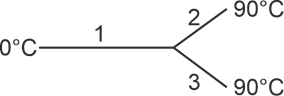
Three rods made of the same material and having the same cross-section have been joined as shown in the figure. Each rod is of the same length. The left and right ends are kept at 0°C and 90°C respectively. The temperature of the junction of the three rods will be:
Q13.
The coefficient of thermal conductivity depends upon:
Q14.
Which of the following cylindrical rods will conduct most heat, when their ends are maintained at the same steady temperature?
Q15.
Gravitational force is required for:
Q16.
The layers of atmosphere are heated through:
Q17.
The lengths and radii of two rods made of same material are in the ratios 1:2 and 2:3 respectively. If the temperature difference between the ends for the two rods be the same then in the steady state. The amount of heat flowing per second through them will be in the ratio of
Q18.
Two metal rods, 1 & 2 of same length have same temperature difference between their ends, their thermal conductivities are K1 & K2 and cross sectional areas A1 & A2 respectively. What is required condition for same rate of heat conduction in them.
Q19.
The temperature of hot and cold end of a 20 cm long rod in thermal steady state are at 100°C and 20°C respectively. Temperature at the centre of the rod is
Q20.
Consider a compound slab consisting of two different materials in series having equal thicknesses and thermal conductivities K and 2K, respectively. The equivalent thermal conductivity of the slab is
Q21.
Under steady state, the temperature of a body
Q22.
The area of the glass of a window of a room is 10 m2 and thickness 2 mm. The outer and inner temperature are 40°C and 20°C respectively. Thermal conductivity of glass in MKS system is 0.2 then heat flowing in the room per second will be
Q23.
If the coefficient of conductivity of aluminium is 0.5 cal/cm-sec-°C, then in order to conduct 10 cal/sec-cm2 in the steady state, the temperature gradient in aluminium must be
Q24.
The dimensional formula for thermal resistance is
Q25.
The material used in the manufacture of cooker must have (K-coefficient of thermal conductivity, S - specific heat of material used):
Q26.
The cause of air currents from ocean to ground is example of
Q27.
On a cold morning, a person will feel metal surface colder to touch than a wooden surface because
Q28.
The heat is flowing through two cylindrical rods of same material. The diameters of the rods are in the ratio 1:2 and their lengths are in the ratio 2:1. If the temperature difference between their ends is the same, the ratio of rate of flow of heat through them will be
Q29.
The requirement for heat conduction to take place in a solid is
Q30.
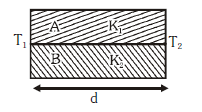
Two rods A and B of different materials are welded together as shown in figure. Their thermal conductivities are K1 and K2. The thermal conductivity of the composite rod will be
Q31.
In a steady state of heat conduction, the temperature of the ends A and B of a rod 100 cm long are 0°C and 100°C. The temperature of the rod at a point 60 cm distant from the end A is
Q32.
Two rods of same length and material transfer a given amount of heat in 12 s when they are joined end to end (in series). When they are joined in parallel, they will transfer same heat under same conditions in
Q33.
An aluminium meter rod of area of cross section 4 cm2 with K = 0.5 cal/cm-s-°C is observed that at steady state 360 cal of heat flows per minute. The temperature gradient along the rod is
Q34.
Two identical rods are made of different materials whose thermal conductivities are K1 and K2. They are placed end to end between two heat reservoirs at temperature θ1 and θ2 as shown in figure. The temperature of the junction of the rods is
Q35.
One end of metal bar of area of cross section 5 cm2 and 25 cm in length is in steam, other in contact with ice. The amount of ice melts in one minute is (L = 80 cal/g & K = 0.8 cgs units)
Q36.
The coefficient of thermal conductivity depends upon
Q37.
Two identical rods AC and CB made of two different metals having thermal conductivities in ratio 2:3 are kept in contact with each other at the end C as shown in figure. A is at 100°C and B is at 25°C. Then the junction C is at
Q38.
There are two identical vessels filled with equal amounts of ice. The vessels are of different metals. If the ice melts in the two vessels in 20 and 35 minutes respectively, the ratio of the coefficients of thermal conductivity of the two metals is
Q39.
Which of the following rods made of same material will conduct more heat in a given time when their ends are maintained at the same temperatures difference.
Q40.
The ratio of thermal conductivity of two rods of different material is 5:4. The two rods of same area of cross-section and same thermal resistance will have the lengths in the ratio
Q41.
A cylindrical rod with one end in a steam chamber and the other end is in ice. It is found that 1 gm of ice melts per second. If the rod is replaced by another one of same material double the length and double area of cross section, The mass of ice that melts per second is
Q42.
Under steady state the temperature of a body
Q43.
Two plates of same area are placed in contact. Their thickness as well as thermal conductivities are in the ratio 2:3. The outer surface of one plate is maintained at 10°C and that of other at 0°C. What is the temperature of the common surface?
Q44.
Three rods A, B and C have the same dimensions. Their conductivities are KA, KB and KC respectively. A and B are placed end to end, with their free ends kept at certain temperature difference. C is placed separately with its ends kept at same temperature difference. The two arrangements conduct heat at the same rate. KC must be equal to
Q45.
Two identical slabs are welded end to end and 20 cal of heat flows through it for 4 min. If the two slabs are now welded by placing them one above the other, and the same heat is flowing through two ends under the same difference of temperatures, the time taken is
Q46.
Two slabs A and B of equal surface area are placed one over the other such that their surfaces are completely in contact. The thickness of slab A is twice that of B. The coefficient of thermal conductivity of slab A is twice that of B. The first surface of slab A is maintained at 100°C, while the second surface of slab B is maintained at 25°C. The temperature at the contact of their surfaces is
Q47.
Two metal plates of same area and thickness l1 and l2 are arranged in series. If the thermal conductivities of the materials of the two plates are k1 and k2, the thermal conductivity of the combination assuming lengths to be same is
Q48.
Two walls of thickness l1 and l2 and thermal conductivities k1 and k2 are in contact. In the steady state, if the temperature at the outer faces are T1 and T2, the temperature at the common wall is
Q49.
Two hollow spheres of same material, one with double the radius of the other and double the thickness of the other, are filled with ice. The ratio of times in which ice gets melted in the two spheres is
Q50.
Two rods of length l and 2l, thermal conductivities 2K and K are connected end to end. If cross sectional areas of two rods are equal, then equivalent thermal conductivity of the system is
Q51.
A perfect black body is one whose emissive power is
Q52.
The plots of intensity versus wavelength for three black bodies at temperatures T1, T2 and T3 respectively are shown. Their temperatures are such that
Q53.
According to Wien's law
Q54.
Solar radiation emitted by sun resembles that emitted by a black body at a temperature of 6000 K. Maximum intensity is emitted at a wavelength of about 4800 Å. If the sun was cooled down from 6000 K to 3000 K, then the peak intensity would occur at a wavelength of
Q55.
The temperature of sun is 5500 K and it emits maximum intensity radiation in the yellow region (5.5 × 10⁻⁷ m). The maximum radiation from a furnace occurs at wavelength 11 × 10-7 m. The temperature of furnace is
Q56.
The wavelength of maximum energy released during an atomic explosion was 2.93 × 10⁻¹⁰ m. Given that Wien's constant is 2.93 × 10⁻³ m-K, the maximum temperature attained must be of the order of
Q57.
When the temperature of a black body increases, it is observed that the wavelength corresponding to maximum energy changes from 0.26 µm to 0.13 µm. The ratio of the emissive powers of the body at the respective temperatures is
Q58.
The maximum energy in thermal radiation from a source occurs at the wavelength 4000 Å. The effective temperature of the source is (Take b = 2.93 × 10⁻³ mK)
Q59.
A black body emits radiation of maximum intensity for the wavelength of 5000 Å when the temperature of the body is 1227°C. If the temperature of the body is increased by 1000°C, the maximum intensity would be observed at
Q60.
A black body has maximum wavelength λm at temperature 2000 K. Its corresponding wavelength at temperature 3000 K will be
Q61.
For an enclosure maintained at 1000 K the maximum radiation occurs at wavelength λm. If the temperature is raised to 2000 K, the peak will shift to
Q62.
The maximum wavelength of radiation emitted at 2000 K is 4 µm. What will be the maximum wavelength of radiation emitted at 2400 K?
Q63.
A body with area A at maintained temperature T and emissivity e = 0.6 is kept inside a spherical black body. What will be the maximum energy radiated per second?
Q64.
Two spheres of same material have radii 1 m and 4 m and temperatures 4000 K and 2000 K respectively. The ratio of energy radiated per second by the first sphere to that of second is
Q65.
A body of area 1 cm2 is heated to a temperature 1000 K. The amount of energy radiated by the body in 1 s is (Stefan's constant σ = 5.67 × 10⁻⁸ Wm-2K-4)
Q66.
The amount of heat energy radiated by a metal at temperature T is E. When the temperature is increased to 3T, energy radiated is
Q67.
A body of length 1 m having cross-sectional area 0.75 m2 has heat flow through it at the rate of 6000 J/s. Then find the temperature difference if K = 200 Jm-1K-1.
Q68.
How many watt of energy is required to keep a black body in the form of a cube of side 1 cm at 2000 K? (Temperature of surrounding is 27°C & σ = 5.67 × 10⁻⁸ Wm-2K-4)
Q69.
Two spheres of the same material have radii 1 m and 4 m and temperature 4000 K and 2000 K respectively. The energy radiated per second by the first sphere is
Q70.
A spherical black body with a radius of 12 cm radiates 450 W power at 500 K. If the radius were halved and the temperature doubled, the power radiated in watt should be
Q71.
Two objects A & B have exactly the same shape and are radiating the same power. If their emissivities are 0.1 and 0.9, the ratio of their temperatures is
Q72.
The energy emitted per second by a black body at 27°C is 10 J. If the temperature of the black body is increased to 327°C, the energy emitted per second will be
Q73.
If the temperature of a black body increases from -73°C to 327°C, then ratio of emissive power at these two temperatures is
Q74.
Two black bodies at 327°C and 627°C are suspended in an environment at 27°C. The ratio of their emissive powers is
Q75.
A metal piece is heated up to T K; the temperature of the surrounding is t K. The heat loss to the surrounding due to radiation is proportional to
Q76.
A black body at 127°C emits the energy at the rate of 106 J/m2s. The temperature of a black body at which the rate of energy emission is 16 × 106 J/m2s is
Q77.
Two bodies of same shape, same size and same radiating power have emissivities 0.2 and 0.8. The ratio of their temperature is
Q78.
If the temperature of the sun is doubled, the rate of energy received on earth will be increased by a factor of
Q79.
The rates of heat radiation from two patches of skin each of area A, on a patient's chest differ by 2%. If the patch of the lower temperature is at 300 K and emissivity of both the patches is assumed to be unity, the temperature of other patch would be
Q80.
A spherical black body with a radius of 12 cm radiates 450 W power at 500 K. If the radius were halved and the temperature doubled, the power radiated in watts would be
Q81.
Assuming the sun to be a spherical body of radius R at a temperature T K, evaluate the total radiant power incident on earth, at a distance r from the sun. (Take r0 is radius of earth and σ Stefan's constant)
Q82.
A black body radiates 20 W power at temperature 227°C. If temperature of the black body is changed to 727°C then its radiating power will be
Q83.
A radiation of energy E falls normally on a perfectly reflecting surface. The momentum transferred to the surface is
Q84.
A black body is at a temperature 300 K. It emits energy at a rate, which is proportional to
Q85.
If the temperature of the sun were to increase from T to 2T and its radius from R to 2R, then the ratio of the radiant energy received on earth to what it was previously, will be
Q86.
The radiation emitted by a star A is 10,000 times that of the sun. If the surface temperature of the sun and the star A are 6000 K and 2000 K respectively, the ratio of the radii of the star A and the sun is
Q87.
A spherical black body with a radius of 12 cm radiates 450 W power at 500 K. If the radius were halved and the temperature doubled, the power radiated in watt would be
Q88.
Two electric bulbs have filaments of lengths L and 2L, diameters 2d and d and emissivities 3e and 4e. If their temperatures are in the ratio 2:3, their powers will be in the ratio of
Q89.
Two spherical black bodies of radii R1 and R2 having surface temperatures T1 and T2 respectively radiate the same powers, then R1/R2 is equal to
Q90.
If the absolute temperature of a black body is doubled, the percentage increase in the rate of loss of heat by radiation is
Q91.
A black metal foil is warmed by radiation from a small sphere at temperature T and at a distance d. It is found that the power received by the foil is P. If both the temperature and the distance are doubled, the power received by the foil will be
Q92.
The temperature of a black body is increased by 50%. The amount of radiation emitted by the body increases by:
Q93.
A pan filled with hot food cools from 94°C to 86°C in 2 minutes, when the room temperature is 20°C. How long will it take to cool from 71°C to 69°C? Assume Newton's law of cooling to be correct.
Q94.
In a room where the temperature is 30°C a body cools from 61°C to 59°C in 4 minute. The time taken by the body to cool from 51°C to 49°C will be
Q95.
A body cools from 70°C to 60°C in 8 minute. The same body cools from 60°C to 50°C in
Q96.
A body cools from 60°C to 50°C in 10 min. If room temperature is 25°C, temperature of body at the end of next 10 minutes will be
Q97.
A body cools from 80°C to 64°C in 5 min and same body cools from 80°C to 52°C in 10 min. What is the temperature of the surrounding?