Q1.
The plant parts which consist of two generations- one within the other (1) pollen grains inside the anther (2) germinated pollen grain with two male gametes (3) seed inside the fruit (4) embryo sac inside the ovule
Q2.
In water hyacinth and water lily, pollination takes place by
Q3.
Which is the most common type of embryo sac in angiosperms?
Q4.
What type of pollination takes place in Vallisneria?
Q5.
In which one of the following, both autogamy and geitonogamy are prevented?
Q6.
Pollen grains can be stored for several years in liquid nitrogen having a temperature of
Q7.
Which of the following has proved helpful in preserving pollen as fossils?
Q8.
Winged pollen grains are present in
Q9.
Functional megaspore in an angiosperm develops into an
Q10.
Attractants and rewards are required for
Q11.
Flowers which have single ovule in the ovary and are packed into inflorescence are usually pollinated by
Q12.
A dioecious flowering plant prevents both
Q13.
In majority of angiosperms
Q14.
Pollination in water hyacinth and water lily is brought about by the agency of
Q15.
The ovule of an angiosperm is technically equivalent to
Q16.
Which one of the following statements is not true?
Q17.
Which of the following statements is not correct?
Q18.
Proximal end of the filament of stamen is attached to the
Q19.
Filiform apparatus is characteristic feature of
Q20.
In angiosperms, microsporogenesis and megasporogenesis
Q21.
Male gametophyte in angiosperms produces
Q22.
Which of the following are the important floral rewards to the animal pollinators?
Q23.
Which one of the following may require pollinators, but is genetically similar to autogamy?
Q24.
Which one of the following statements is not true?
Q25.
The hilum is a scar on the
Q26.
Transmission tissue is characteristic feature of
Q27.
Geitonogamy involves
Q28.
Pollen tablets are available in the market for
Q29.
Function of filiform apparatus is to
Q30.
Advantage of cleistogamy is
Q31.
Megasporangium is equivalent to
Q32.
Which one of the following statements is correct?
Q33.
Animal vectors are required for pollination in
Q34.
Megaspores are produced from the megaspore mother cells after
Q35.
Which one of the following statements is correct?
Q36.
Which of the following statements is correct?
Q37.
Both, autogamy and geitonogamy are prevented in
Q38.
An organic substance that can withstand environmental extremes and cannot be degraded by any enzyme is
Q39.
Even in absence of pollinating agents seed-setting is assured in
Q40.
What is the function of germ pore?
Q41.
Plants with ovaries having only one or a few ovules, are generally pollinated by
Q42.
Filiform apparatus is a characteristic feature of
Q43.
Which one of the following pollinations is autogamous?
Q44.
Wind pollination is common in
Q45.
In angiosperms, functional megaspore develops into
Q46.
Transfer of pollen grains from the anther to the stigma of another flower of the same plant is called
Q47.
Wind pollinated flowers are
Q48.
Which one of the following pairs of plant structures has haploid number of chromosomes?
Q49.
What does the filiform apparatus do at the entrance into ovule?
Q50.
Unisexuality of flowers prevents
Q51.
Which one of the following is resistant to enzyme action?
Q52.
Male gametes in angiosperms are formed by the division of
Q53.
Which one of the following is surrounded by a callose wall?
Q54.
The arrangement of the nuclei in a normal embryo sac in the dicot plants is
Q55.
Which one of the following represents an ovule, where the embryo sac becomes horse-shoe shaped and the funiculus and micropyle are close to each other?
Q56.
An ovule which becomes curved so that the nucellus and embryo sac lie at right angles to the funicle is
Q57.
Anthesis is a phenomenon which refers to
Q58.
In a flowering plant, archesporium gives rise to
Q59.
In angiosperm, all the four microspores of tetrad are covered by a layer which is formed by
Q60.
What is the direction of micropyle in anatropous ovule?
Q61.
In grasses what happens in microspore mother cell for the formation of mature pollen grains?
Q62.
Anemophily type of pollination is found in
Q63.
Eight nucleated embryo sac is
Q64.
If there are 4 cells in anthers, what will be the number of pollen grains?
Q65.
The anthesis is a phenomenon, which refers to
Q66.
In an angiosperm, how many microspore mother cells are required to produce 100 pollen grains?
Q67.
When pollen of a flower is transferred to the stigma of another flower of the same plant, the pollination is referred to as
Q68.
Embryo sac represents
Q69.
Number of meiotic divisions required to produce 200/400 seeds of pea would be
Q70.
Ovule is straight with funiculus, embryo sac, chalaza and micropyle lying on one straight line. It is
Q71.
Meiosis is best observed in dividing
Q72.
Point out the odd one.
Q73.
Pollination occurs in
Q74.
Entry of pollen tube through micropyle is
Q75.
Female gametophyte of angiosperms is represented by
Q76.
Male gametophyte of angiosperms/monocots is
Q78.
Generative cell was destroyed by laser but a normal pollen tube was still formed because
Q79.
Total number of meiotic divisions required for forming 100 zygotes/100 grains of wheat is
Q80.
Male gametophyte of angiosperms is shed at
Q81.
What is the fate of the male gametes discharged in the synergid?
Q82.
Double fertilisation is
Q83.
Double fertilisation is exhibited by
Q84.
Which one of the following statements is wrong?
Q85.
Through which cell of the embryo sac, does the pollen tube enter the embryo sac?
Q86.
In angiosperms, pollen tube liberate their male gametes into the
Q87.
Endosperm is formed during the double fertilisation by
Q88.
The role of double fertilisation in angiosperms is to produce
Q89.
Double fertilisation is characteristic of
Q90.
Double fertilisation is fusion of
Q92.
Which of the following pair have haploid structures?
Q93.
Double fertilisation and triple fusion were discovered by
Q94.
Persistent nucellus in the seed is known as
Q95.
Which one of the following statements regarding post-fertilisation development in flowering plants is incorrect?
Q96.
The coconut water from tender coconut represents
Q97.
Coconut water from a tender coconut is
Q98.
Which one of the following fruits is parthenocarpic?
Q99.
Non-albuminous seed is produced in
Q100.
Seed coat is not thin, membranous in
Q101.
Perisperm differs from endosperm in
Q102.
Albuminous seeds store their reserve food mainly in
Q103.
The viability of seeds is tested by
Q104.
Two plants can be conclusively said to belong to the same species if they
Q105.
In a cereal grain the single cotyledon of embryo is represented by
Q106.
The embryo in sunflower has
Q107.
Embryo sac occurs in
Q109.
Tegmen develops from
Q110.
Seed formation without fertilisation in flowering plants involves the process of
Q111.
Nucellar polyembryony is reported in species of
Q112.
What is common between vegetative reproduction and apomixis?
Q113.
Apomictic embryos in Citrus arise from
Q114.
In a type of apomixis known as adventive embryony, embryos develop directly from the
Q115.
Adventive embryony in Citrus is due to
Q116.
The polyembryony commonly occurs in
Q117.
Study of formation, growth and development of new individual from an egg is
Q119.
Development of an organism from female gamete/egg without involving fertilization is
Q120.
Formation of gametophyte directly from sporophyte without meiosis is
Q121.
Prothallus (gametophyte) gives rise to fern plant (sporophyte) without fertilization. It is
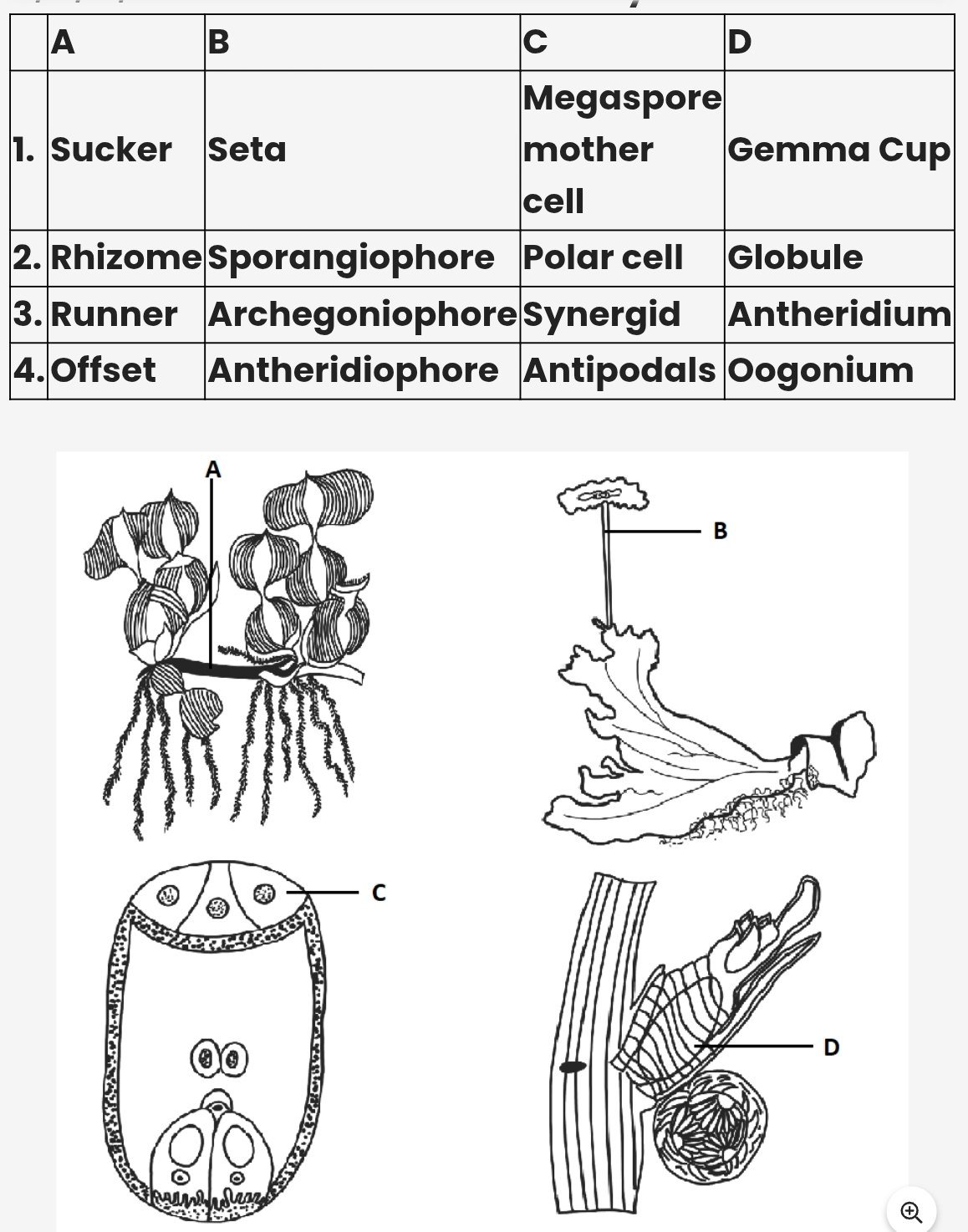
Q122.
Examine the figures (A-D) given below and select
the right option out of (a – d), in which all the four
structures A, B, C and D are identified correctly.