Q1.
Conversion of glucose to glucose-6-phosphate, the first irreversible reaction of glycolysis, is catalysed by
Q2.
What is the role of NAD+ in cellular respiration?
Q3.
In glycolysis, during oxidation electrons are removed by
Q4.
At the end of glycolysis, six carbon compound ultimately changes into
Q5.
The first phase in the breakdown of glucose, in animal cell, is
Q6.
End product of glycolysis is
Q7.
In which one of the following processes CO2 is not released?
Q8.
The energy-releasing metabolic process in which substrate is oxidised without an external electron acceptor is called
Q9.
In alcohol fermentation
Q10.
The end product of fermentation are
Q11.
Which of the following products are obtained by anaerobic respiration from yeast?
Q12.
When yeast ferments glucose, the products obtained are
Q13.
The number of substrate level phosphorylations in one turn of citric acid cycle is
Q14.
Where is respiratory electron transport system (ETS) located in plants?
Q15.
Which of these statements is incorrect?
Q16.
Which statement is wrong for Krebs' cycle?
Q17.
Oxidative phosphorylation is
Q18.
Cytochromes are found in
NEET 2015 Cancelled
medium
Q19.
In mitochondria, protons accumulate in the
Q20.
All enzymes of TCA cycle are located in the mitochondrial matrix except one which is located in inner mitochondrial membranes in eukaryotes and in cytosol in prokaryotes. This enzyme is
Q21.
In which one of the following do the two names refer to one and the same thing?
Q23.
Which one of the following statements about cytochrome P450 is wrong?
Q24.
Which of the following is the key intermediate compound linking glycolysis to the Krebs' cycle?
Q25.
In Krebs' cycle, the FAD precipitates as electron acceptor during the conversion of
Q26.
The correct sequence of electron acceptor in ATP synthesis is
Q27.
The 1992 Nobel Prize for medicine was awarded to Edmond H. Fischer and Edwin J. Krebs for their work concerning
Q28.
End product of citric acid cycle/Krebs' cycle is
Q29.
Oxidative phosphorylation is production of
Q30.
End products of aerobic respiration are
Q31.
Terminal cytochrome of respiratory chain which donates electrons to oxygen is
Q32.
Connecting link between glycolysis and Krebs' cycle before pyruvate entering Krebs' cycle is changed to
Q33.
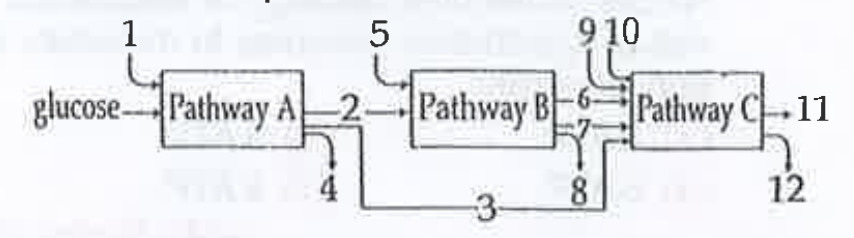
The three boxes in this diagram represent the three major biosynthetic pathways in aerobic respiration. Arrows represent net reactants or products. Arrows numbered 4, 8 and 12 can all be
Q34.
The overall goal of glycolysis, Krebs' cycle and the electron transport system is the formation of
Q35.
How many ATP molecules could maximally be generated from one molecule of glucose, if the complete oxidation of one mole of glucose to CO2 and H2O yields 686 kcal and the useful chemical energy available in the high energy phosphate bond of one mole of ATP is 12 kcal?
Q36.
During which stage in the complete oxidation of glucose are the greatest number of ATP molecules formed from ADP?
Q37.
How many ATP molecules are produced by aerobic oxidation of one molecule of glucose?
Q38.
Net gain of ATP molecules, during aerobic respiration, is
Q39.
When one molecule of ATP is disintegrated, what amount of energy is liberated?
Q40.
The ultimate respiratory substrate, yielding maximum number of ATP molecules, is
Q41.
Out of 38 ATP molecules produced per glucose, 32 ATP molecules are formed from NADH/FADH2 in
Q42.
When one glucose molecule is completely oxidised, it changes
Q43.
Out of 36 ATP molecules produced per glucose molecule during respiration
Q44.
EMP can produce a total of
Q45.
Which of the following biomolecules is common to respiration-mediated breakdown of fats, carbohydrates and proteins?
Q46.
Which of the metabolites is common to respiration-mediated breakdown of fats, carbohydrates and proteins?
Q47.
Aerobic respiratory pathway is appropriately termed
Q48.
Plants, but not animals, can convert fatty acids to sugars by a series of reactions called
Q49.
Link between glycolysis, Krebs' cycle and β-oxidation of fatty acid or carbohydrate and fat metabolism is
Q50.
NADP+ is reduced to NADPH in
Q51.
Respiratory Quotient (RQ) value of tripalmitin is
Q52.
Apparatus to measure rate of respiration and R.Q. is