Q1.
In context of amniocentesis, which of the following statements is incorrect?
Q2.
Which of the following cannot be detected in a developing fetus by amniocentesis?
Q3.
The permissible use of the technique amniocentesis is for
Q4.
Fetal sex can be determined by examining cells from the amniotic fluid by looking for
Q5.
Which of the following contraceptive methods involve a role of hormone?
Q6.
Select the hormone-releasing Intra-Uterine Devices.
Q7.
Which of the following is a correct statement?
Q8.
The contraceptive Saheli
Q9.
The function of copper ions in copper releasing IUDs is
Q10.
Which of the following is hormone-releasing IUD?
Q11.
Which of the following is incorrect regarding vasectomy?
Q12.
Which of the following approaches does not give the defined action of contraceptive?
Q13.
Tubectomy is a method of sterilisation in which
Q14.
Which of the following is a hormone releasing Intra Uterine Device (IUD)?
Q15.
One of the following is not a method of contraception. Which one?
Q16.
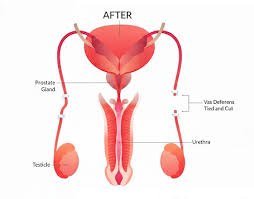
What is the figure given below showing in particular?
Q17.
Which one of the following is the most widely accepted method of contraception in India at present?
Q18.
Cu ions released from copper-releasing intra uterine devices (IUDs)
Q19.
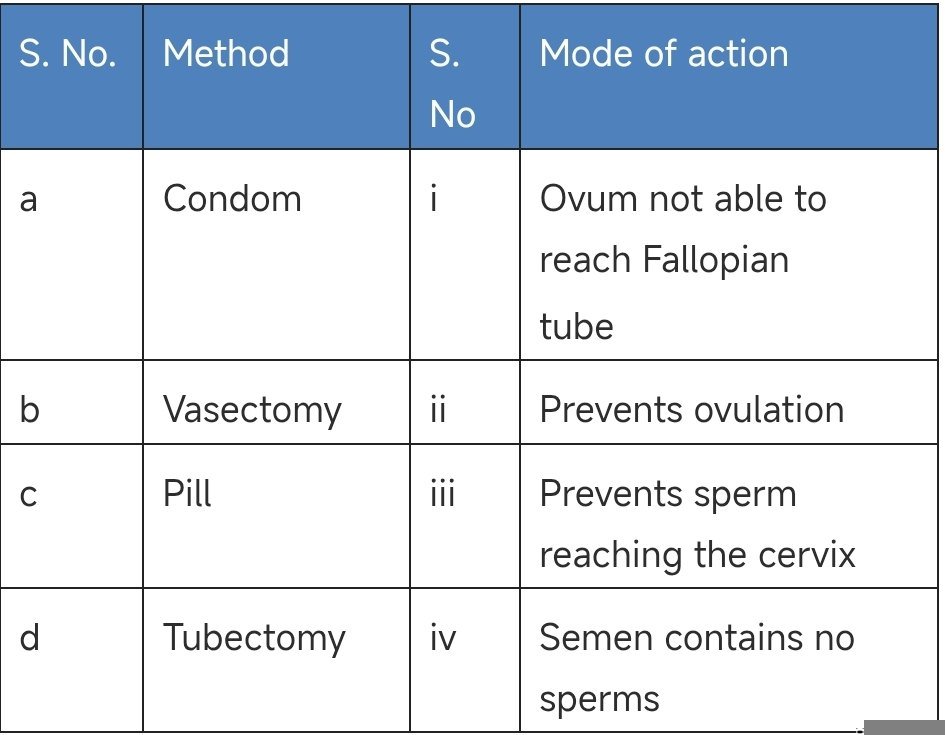
Given below are four methods (A-D) and their modes of action (i-iv) in achieving contraception. Select their correct matching from the four options that follow.
Q20.
What is the work of copper-T?
Q21.
What is the work of progesterone which is present in oral contraceptive pills?
Q22.
Tablets to prevent male contraception contain
Q23.
The most important component of the oral contraceptive pills is
Q24.
The present population of the world is about
Q25.
One of the legal methods of birth control is
Q26.
Medical Termination of Pregnancy (MTP) is considered safe up to how many weeks of pregnancy?
Q27.
Consider the statements given below regarding contraception and answer as directed thereafter. (1) Medical termination of pregnancy (MTP) during first trimester is generally safe. (2) Generally chances of conception are nil until mother breast-feeds the infant upto two years. (3) Intrauterine devices like copper-T are effective contraceptives. (4) Contraception pills may be taken upto one week after coitus to prevent conception. Which two of the above statements are correct?
Q28.
Select the option including all sexually transmitted diseases.
Q29.
Which of the following sexually transmitted diseases is not completely curable?
Q30.
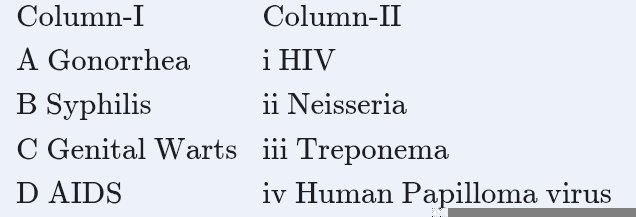
Match the following sexually transmitted diseases (column I) with their causative agent (column II) and select the correct option.
Q31.
Which of the following is not a sexually transmitted disease?
Q32.
Which one of the following statements is correct regarding sexually transmitted diseases (STDs)?
Q33.
Which one of the following does correctly match a sexually transmitted disease with its pathogen?
Q34.
In which of the following techniques, the embryos are transferred to assist those females who cannot conceive?
Q35.
In case of a couple where the male is having a very low sperm count, which technique will be suitable for fertilisation?
Q36.
Embryo with more than 16 blastomeres formed due to in vitro fertilisation is transferred into
Q37.
A childless couple can be assisted to have a child through a technique called GIFT. The full form of this technique is
Q38.
Assisted reproductive technology, IVF involves transfer of
Q39.
Artificial Insemination means
Q40.
The stage transferred into the uterus after induced fertilisation of ovum in the laboratory is
Q41.
The test-tube baby programme employs which one of the following techniques?
Q42.
The technique called Gamete Intra Fallopian Transfer (GIFT) is recommended for those females
Q43.
In vitro fertilisation is a technique that involves transfer of which one of the following into the fallopian tube?
Q44.
Test tube baby means a baby born when
Q45.
The test tube baby means
Q46.
Which of the following statements is correct with reference to a test tube baby?