Q1.
How many true breeding pea plant varieties did Mendel select as pairs, which were similar except in one character with contrasting traits?
Q2.
Among the following characters, which one was not considered by Mendel in his experiments on pea?
Q3.
Which one from those given below is the period for Mendels hybridisation experiments?
Q4.
In his classic experiments on pea plants, Mendel did not use
Q5.
How many pairs of contrasting characters in pea plants were studied by Mendel in his experiments?
Q6.
Which one of the following traits of garden pea studied by Mendel was a recessive feature?
Q7.
The genes controlling the seven pea characters studied by Mendel are now known to be located on how many different chromosomes?
Q8.
According to Mendelism, which character shows dominance?
Q9.
First geneticist/father of genetics was
Q10.
Which contribute to the success of Mendel?
Q11.
Identify the wrong statement with reference to the gene I that controls ABO blood groups.
Q12.
In Antirrhinum (Snapdragon), a red flower was crossed with a white flower and in F1 generation all pink flowers were obtained. When pink flowers were selfed, the F2 generation showed white, red and pink flowers. Choose the incorrect statements from the following.
Q13.
The genotypes of a husband and wife are IAIB and IAi. Among the blood types of their children, how many different genotypes and phenotypes are possible?
Q14.
A tall true breeding garden pea plant is crossed with a dwarf true breeding garden pea plant. When the F1 plants were selfed the resulting genotypes were in the ratio of
Q15.
A gene showing co-dominance has
Q17.
Multiple alleles are present
Q18.
A man with blood group A marries a woman with blood group B. What are all the possible blood groups of their offspring?
Q19.
If two persons with AB blood group marry and have sufficiently large number of children, these children could be classified as A blood group: AB blood group: B blood group in 1:2:1 ratio. Modern technique of protein electrophoresis reveals presence of both A and B type proteins in AB blood group individuals. This in an example of
Q20.
Which idea is depicted by a cross in which the F1 generation resembles both the parents?
Q21.
F2 generation in a Mendelian cross showed that both genotypic and phenotypic ratios are same as 1:2:1. It represents a case of
Q22.
A test cross is carried out to
Q23.
Test cross in plants or in Drosophila involves crossing
Q24.
ABO blood groups in humans are controlled by the gene I. It has three alleles - IA, IB and i. Since there are three different alleles, six different genotypes are possible. How many phenotypes can occur?
Q25.
The genotype of a plant showing the dominant phenotype can be determined by
Q26.
Which one of the following cannot be explained on the basis of Mendels law of dominance?
Q27.
ABO blood grouping is controlled by gene I which has three alleles and show co-dominance. There are six genotypes. How many phenotypes in all are possible?
Q28.
A cross in which an organism showing a dominant phenotype is crossed with the recessive parent in order to know its genotype is called
Q29.
In Antirrhinum two plants with pink flowers were hybridized. The F1 plants produced red, pink and white flowers in the proportion of 1 red, 2 pink and 1 white. What could be the genotype of the two plants used for hybridisation? Red flower colour is determined by RR and white by rr genes.
Q30.
In pea plants, yellow seeds are dominant to green. If a heterozygous yellow seeded plant is crossed with a green seeded plant, what ratio of yellow and green seeded plants would you expect in F1 generation?
Q31.
A common test to find the genotype of a hybrid is by
Q33.
Phenotype of an organism is the result of
Q34.
A gene is said to be dominant if
Q35.
When dominant and recessive alleles express itself together it is called
Q36.
In hybridisation, Tt × tt gives rise to the progeny of ratio
Q37.
A childs blood group is O. The parents blood groups cannot be
Q38.
A child of O-group has B-group father. The genotype of father will be
Q39.
An allele is dominant if it is expressed in
Q40.
An organism with two identical alleles is
Q41.
A man of A-blood group marries a woman of AB blood group. Which type of progeny would indicate that man is heterozygous A?
Q42.
Multiple alleles control inheritance of
Q43.
The contrasting pairs of factors in Mendelian crosses are called
Q45.
Blue eye colour is recessive to brown eye colour. A brown eyed man whose mother was blue eyed marries a blue-eyed woman. The children will be
Q46.
RR (Red) Antirrhinum is crossed with white (WW) one. Offspring RW are pink. This is an example of
Q47.
ABO blood group system is due to
Q48.
tt mates with Tt. What will be characteristic of offspring?
Q49.
Haploids are able to express both recessive and dominant alleles/mutations because there are
Q50.
Experimental verification of the chromosomal theory of inheritance was done by
Q51.
What map unit (centimorgan) is adopted in the construction of genetic maps?
Q52.
The frequency of recombination between gene present on the same chromosome as a measure of the distance between genes was explained by
Q53.
The mechanism that causes a gene to move from one linkage group to another is called
Q54.
In a test cross involving F1 dihybrid flies, more parental-type offspring were produced than the recombinant-type offspring. This indicates
Q55.
The term linkage was coined by
Q56.
The movement of a gene from one linkage group to another is called
Q57.
Fruit colour in squash is an example of
Q58.
Which of the following statements is not true of two genes that show 50% recombination frequency?
Q59.
When two unrelated individuals or lines are crossed, the performance of F1 hybrid is often superior to both its parents. This phenomenon is called
Q60.
Select the correct statement from the ones given below with respect to dihybrid cross.
Q61.
A human male produces sperms with the genotypes AB, Ab, aB and ab pertaining to two diallelic characters in equal proportions. What is the corresponding genotype of this person?
Q62.
In Mendels experiments with garden pea, round seed shape (RR) was dominant over wrinkled seeds (rr), yellow cotyledon (YY) was dominant over green cotyledon (yy). What are the expected phenotypes in the F2 generation of the cross RRYY × rryy?
Q63.
In order to find out the different types of gametes produced by a pea plant having the genotype AaBb it should be crossed to a plant with the genotype
Q64.
In a plant, red fruit (R) is dominant over yellow fruit (r) and tallness (T) is dominant over shortness (t). If a plant with RRTt genotype is crossed with a plant that is rrtt,
Q65.
Lack of independent assortment of two genes A and B in fruit fly Drosophila is due to
Q66.
Two crosses between the same pair of genotypes or phenotypes in which the sources of the gametes are reversed in one cross, is known as
Q67.
There are three genes a, b, c. Percentage of crossing over between a and b is 20%, b and c is 28% and a and c is 8%. What is the sequence of genes on chromosome?
Q68.
Two non-allelic genes produces the new phenotype when present together but fail to do so independently then it is called
Q69.
A and B genes are linked. What shall be genotype of progeny in a cross between AB/ab and ab/ab?
Q70.
Ratio of complementary genes is
Q71.
Independent assortment of genes does not take place when
Q72.
Due to the cross between TTRr × ttrr the resultant progenies show what percent of tall, red flowered plants?
Q73.
A gene pair hides the effect of another gene. The phenomenon is called
Q74.
If Mendel had studied the seven traits using a plant with 12 chromosomes instead of 14, in what way would his interpretation have been different?
Q75.
Crossing over in diploid organism is responsible for
Q76.
A fruit fly is heterozygous for sex-linked genes, when mated with normal female fruit fly, the males specific chromosome will enter egg cell in the proportion
Q77.
When two dominant independently assorting genes react with each other, they are called
Q78.
When two genetic loci produce identical phenotypes in cis and trans position, they are considered to be
Q79.
The phenomenon, in which an allele of one gene suppresses the activity of an allele of another gene, is known as
Q80.
Which of the following is suitable for experiment on linkage?
Q81.
Two dominant nonallelic genes are 50 map units apart. The linkage is
Q82.
Mendel studied inheritance of seven pairs of traits in pea which can have 21 possible combinations. If you are told that in one of these combinations, independent assortment is not observed in later studies, your reaction will be
Q83.
In a cross between AABB × aabb, the ratio of F2 genotypes between AABB, AaBB, Aabb and aabb would be
Q84.
Segregation of Mendelian factors (no linkage, no crossing over) occurs during
Q85.
The allele which is unable to express its effect in the presence of another is called
Q86.
Cross between AaBB and aaBB will form
Q87.
In a genetic cross having recessive epistasis, F2 phenotypic ratio would be
Q88.
Bateson used the terms coupling and repulsion for linkage and crossing over. Name the correct parental of coupling type alongwith its cross over or repulsion.
Q89.
Segregation of Mendelian factor (Aa) occurs during
Q90.
Two linked genes a and b show 20% recombination. the individuals of a dihybrid cross between ++/++ × ab/ab shall show gametes
Q91.
Which of the following characteristics represent inheritance of blood groups in humans? (i) Dominance (ii) Co-dominance (iii) Multiple allele (iv) Incomplete dominance (v) Polygenic inheritance
Q92.
Inheritance of skin colour in humans is an example of
Q93.
How many different kinds of gametes will be produced by a plant having the genotype AABbCC?
Q94.
Which one of the following is an example of polygenic inheritance?
Q95.
On selfing a plant of F1-generation with genotype AABbCC, the genotypic ratio in F2-generation will be
Q96.
In human beings, multiple genes are involved in the inheritance of
Q97.
How many different types of genetically different gametes will be produced by a heterozygous plant having the genotype AABbCc?
Q98.
The polygenic genes show
Q99.
A polygenic inheritance in human beings is
Q100.
Match the terms in column I with their description in column II and choose the correct option.
Q102.
Which of the following is an example of pleiotropy?
Q103.
When a single gene influences more than one trait it is called
Q104.
Select the incorrect statement.
Q105.
Which of the following pairs is wrongly matched?
Q106.
Which one of the following conditions of the zygotic cell would lead to the birth of a normal human female child?
Q107.
In Drosophila, the sex is determined by
Q108.
Number of Barr bodies in XXXX female is
Q109.
Male XX and female XY sometime occur due to
Q110.
Probability of four sons to a couple is
Q111.
Genetic identity of a human male is determined by
Q112.
When an animal has both the characters of male and female, it is called
Q113.
Mr. Kapoor has Bb autosomal gene pair and d allele sex-linked. What shall be proportion of Bd in sperms?
Q114.
Sex is determined in human beings
Q115.
A normal green male maize is crossed with albino female. The progeny is albino because
Q116.
A family of five daughter only is expecting sixth issue. The chance of its being a son is
Q117.
One of the parents of a cross has a mutation in its mitochondria. In that cross, that parent is taken as a male. During segregation of F2 progenies that mutation is found in
Q118.
The most striking example of point mutation is found in a disease called
Q119.
Select the correct match.
Q120.
What is the genetic disorder in which an individual has an overall masculine development, gynaecomastia and is sterile?
Q121.
A woman has an X-linked condition on one of her X chromosomes. This chromosome can be inherited by
Q122.
Thalassemia and sickle cell anaemia are caused due to a problem in globin molecule synthesis. Select the correct statement.
Q123.
A disease caused by an autosomal primary non-disjunction is
Q124.
If a colour-blind man marries a woman who is homozygous for normal colour vision, the probability of their son being colour-blind is
Q125.
Pick out the correct statements. (1) Haemophilia is a sex-linked recessive disease. (2) Downs syndrome is due to aneuploidy. (3) Phenylketonuria is an autosomal recessive gene disorder. (4) Sickle cell anaemia is an X-linked recessive gene disorder.
Q126.
Which of the following most appropriately describes haemophilia?
Q127.
A colour blind man marries a woman with normal sight who has no history of colour blindness in her family. What is the probability of their grandson being colour blind?
Q128.
In the following human pedigree, the filled symbols represent the affected individuals. Identify the type of given pedigree.
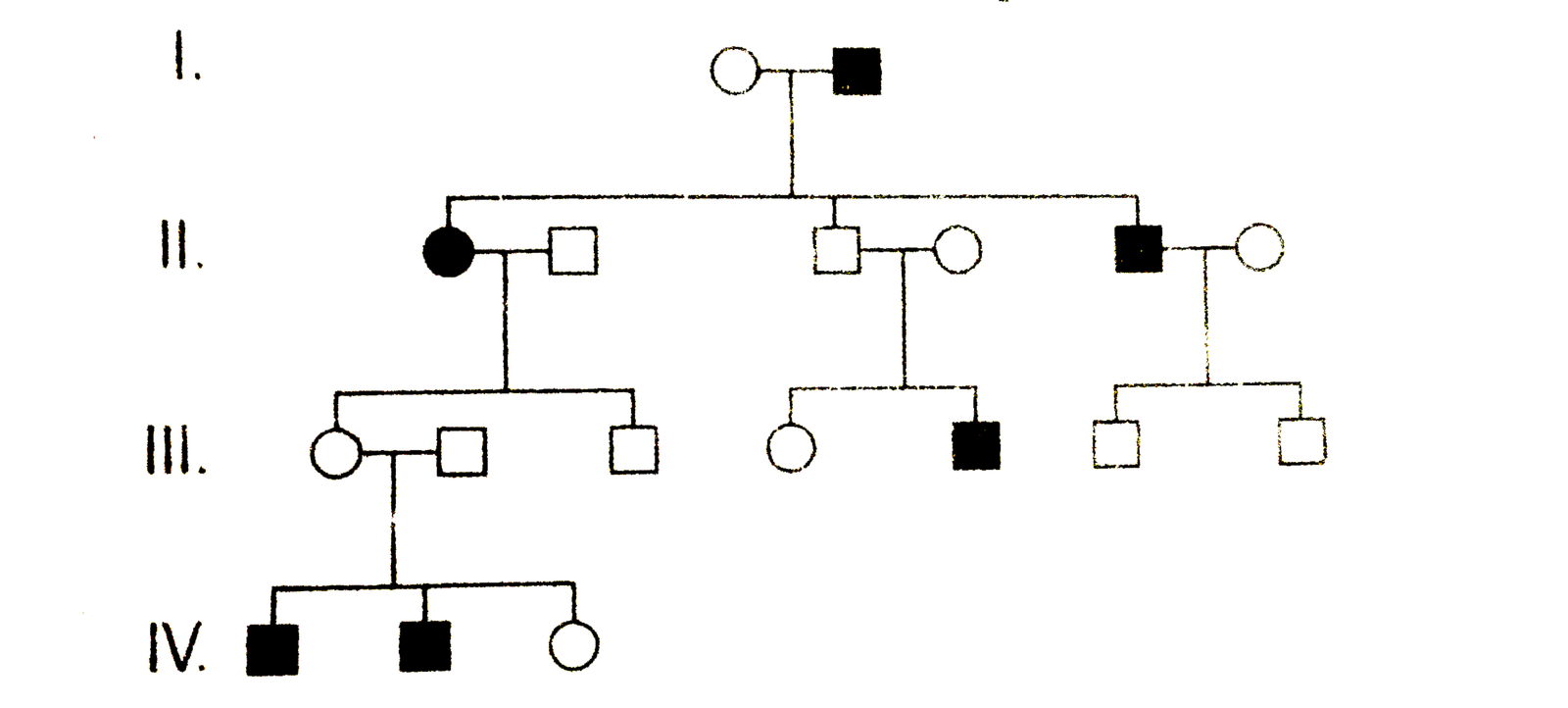
Q129.
An abnormal human baby with XXX sex chromosomes was born due to
Q130.
A man whose father was colour blind marries a woman who had a colour blind mother and normal father. What percentage of male children of this couple will be colour blind?
Q131.
A human female with Turners syndrome
Q132.
Select the incorrect statement with regard to haemophilia.
Q133.
If both parents are carriers for thalassaemia, which is an autosomal recessive disorder, what are the chances of pregnancy resulting in an affected child?
Q134.
Which one is the incorrect statement with regard to the importance of pedigree analysis?
Q135.
Downs syndrome in humans is due to
Q136.
A normal-visioned man whose father was colour-blind, marries a woman whose father was also colour-blind. They have their first child as a daughter. What are the chances that this child would be colour-blind?
Q137.
Represented here is the inheritance pattern of a certain type of trait in humans. Which one of the following conditions could be an example of this pattern?

Q138.
Which one of the following conditions correctly describes the manner of determining the sex?
Q139.
Haemophilia is more commonly seen in human males than in human females because
Q140.
Which of the following is not a hereditary disease?
Q141.
A woman with normal vision, but whose father was colour blind, marries a colour blind man. Suppose that the fourth child of this couple was a boy. This boy
Q142.
A male human is heterozygous for autosomal genes A and B and is also hemizygous for haemophilic gene h. What proportion of his sperms will be abh?
Q143.
A normal woman, whose father was colour-blind is married to a normal man. The sons would be
Q144.
The recessive genes located on X-chromosome humans are always
Q145.
Pattern baldness, moustaches and beard in human males are examples of
Q146.
Which one of the following conditions though harmful in itself, is also potential saviour from a mosquito borne infectious disease?
Q147.
Downs syndrome is caused by an extra copy of chromosome number 21. What percentage of offspring produced by an affected mother and a normal father would be affected by this disorder?
Q148.
Christmas disease is another name for
Q149.
A diseased man marries a normal woman. They get three daughters and five sons. All the daughters were diseased and sons were normal. The gene of this disease is
Q150.
Which of the following is a correct match?
Q151.
Sickle cell anaemia induce to
Q152.
Mongolian Idiocy due to trisomy in 21st chromsome is called
Q153.
In Drosophila, the XXY condition leads to femaleness whereas in human beings the same condition leads to Klinefelters syndrome in male. It proves
Q154.
A marriage between normal visioned man and colour blind woman will produce offspring
Q155.
Haemophilia is more commonly seen in human males than in human females because
Q156.
Which of the following is not a hereditary disease?
Q157.
A woman with normal vision, but whose father was colour blind, marries a colour blind man. Suppose that the fourth child of this couple was a boy. This boy
Q158.
A male human is heterozygous for autosomal genes A and B and is also hemizygous for haemophilic gene h. What proportion of his sperms will be abh?
Q159.
A normal woman, whose father was colour-blind is married to a normal man. The sons would be
Q160.
The recessive genes located on X-chromosome in humans are always
Q161.
Pattern baldness, moustaches and beard in human males are examples of
Q162.
Which one of the following conditions though harmful in itself, is also potential saviour from a mosquito borne infectious disease?
Q163.
Downs syndrome is caused by an extra copy of chromosome number 21. What percentage of offspring produced by an affected mother and a normal father would be affected by this disorder?
Q164.
Christmas disease is another name for
Q165.
A diseased man marries a normal woman. They get three daughters and five sons. All the daughters were diseased and sons were normal. The gene of this disease is
Q166.
Which of the following is a correct match?
Q167.
Sickle cell anaemia induces to
Q168.
Mongolian Idiocy due to trisomy in 21st chromosome is called
Q169.
In Drosophila, the XXY condition leads to femaleness whereas in human beings the same condition leads to Klinefelters syndrome in male. It proves
Q170.
A marriage between normal visioned man and colour blind woman will produce offspring
Q171.
Haemophilic man marries a normal woman. Their offspring will be
Q172.
A woman with two genes for haemophilia and one gene for colour blindness on one of the X chromosomes marries a normal man. How will the progeny be?
Q173.
Mental retardation in man, associated with sex chromosomal abnormality is usually due to
Q174.
Albinism is known to be due to an autosomal recessive mutation. The first child of a couple with normal skin pigmentation was an albino. What is the probability that their second child will also be an albino?
Q175.
A person with the sex chromosomes XXY suffers from
Q176.
In which of the following diseases, the man has an extra X-chromosome?
Q177.
A person whose father is colour blind marries a lady whose mother is daughter of a colour blind man. Their children will be
Q178.
A genetically diseased father (male) marries with a normal female and gives birth to 3 carrier girls and 5 normal sons. It may be which type of genetic disease?
Q179.
An abnormal human male phenotype involving an extra X-chromosome (XXY) is a case of
Q180.
The genes, which remain confined to differential region of Y-chromosome, are
Q181.
Albinism is a congenital disorder resulting from the lack of which enzyme?
Q182.
The colour blindness is more likely to occur in males than in females because
Q183.
Of both normal parents, the chances of a male child becoming colour blind are
Q184.
Of a normal couple, half the sons are haemophiliac while half the daughters are carriers. The gene is located on
Q185.
A colour blind mother and normal father would have
Q186.
Downs syndrome is due to
Q187.
In human beings 45 chromosomes/single X/XO abnormality causes
Q188.
A colour blind girl is rare because she will be born only when
Q189.
In Downs syndrome of a male child, the sex complement is
Q190.
Haemophilia is more common in males because it is a
Q191.
Which one is a hereditary disease?
Q192.
Both husband and wife have normal vision though their fathers were colour blind. The probability of their daughter becoming colour blind is