Q1.
In which of the following gaseous exchange between O2 and CO2 occurs through general body surface?
Q2.
Match the followings correctly.
| Animals | Respiratory Organs |
|---|
| A. Earthworms | 1. Lungs |
| B. Most aquatic arthropods | 2. Trachea |
| C. Fishes | 3. Gills |
| D. Birds/Reptiles | 4. Moist cuticle |
| E. Insects | |
Q3.
Amphibians e.g. frogs respire –
Q4.
Which is the correct sequence of air passages in man?
Q5.
Which is correct about nasopharynx?
Q6.
Which of the following options is wrong about the larynx (sound box)?
Q7.
Trachea divides into right and left primary bronchi at ______ thoracic vertebra.
Q8.
Incomplete cartilaginous rings support all of the following except-
Q9.
Which of the following has the smallest diameter?
Q10.
Lungs are comprised by –
Q11.
Sites of gaseous exchange in lungs are –
Q12.
I.It is double layered and covers the lungs
II. Fluid between the layers reduces friction on lung-surface
III. Outer layer is in contact with thoracic wall
IV. Inner layer is in contact with lungs
The above features refer to –
Q13.
The part starting with the external nostrils upto the terminal bronchioles constitute the -
Q14.
Respiratory or exchange part of the respiratory system consists of-
Q15.
The conducting part of the respiratory system has functions.
Q16.
The chamber formed dorsally by the vertebral column, ventrally by sternum, laterally by ribs and on the lower side by dome-shaped diaphragm is -
Q17.
Respiration involves following steps –
I) Diffusion of gases O2 and CO2 across alveolar membrane
II) Transport of gases by blood
III) Utilization of O2 by cell for catabolic reactions and resultant release of CO2
IV) Pulmonary ventilation by which atmospheric air is drawn in and CO2 rich alveolar air is released out
V) Diffusion of O2 and CO2 between blood and tissues.
The correct sequence of steps is –
Q18.
Study the given diagram and identify A, B, C and D.

Q19.
The lungs expand in inspiration/inhalation because –
Q20.
The process of exhalation / expiration is begun mainly due to –
Q21.
Which of the following statements about the mechanism of ventilation/breathing is false?
Q22.
Inspiration occurs when there is a negative pressure in the lungs with respect to atmospheric pressure. This negative pressure is achieved when –
Q23.
Expiration takes place when the intrapulmonary pressure is –
Q24.
Which of the following sequences is correct to initiate inspiration?
I. The contraction of external intercostal muscles raises the ribs and sternum.
II. Volume of thorax increases in the dorso-ventral axis
III. Intrapulmonary pressure decreases
IV. Diaphragm contraction
V. Air rushes into lungs
VI. Volume of thorax increases in the anterio-posterior axis
Q25.
Which of the following sequences is correct to initiate expiration?
I. Relaxation of external intercostal muscles and return of diaphragm and sternum to their normal position
II. Air expelled from lungs
III. Volume of thorax decreases
IV. Intrapulmonary pressure increases
Q26.
On an average, a healthy human breathes ______ times /minute-
Q27.
Additional muscles for forceful breathing are –
Q28.
Following illustration depicts the mechanism of breathing. In which of the following option all the parts A. B, C and D are correctly labelled?
Q29.
Match the following –
| Column A | Column B |
|---|
| 1. Tidal Volume | A. Tidal volume and inspiratory reserve volume and expiratory reserve volume |
| 2. Residual Volume | B. Additional amount of air inhaled beyond tidal volume when taking a very deep breath |
| 3. Expiratory reserve volume | C. Amount of air remaining in lungs after expiratory reserve volume is expelled |
| 4. Inspiratory reserve volume | D. Tidal volume and inspiratory reserve volume |
| 5. Inspiratory Capacity | E. Volume of air in one breath |
| 6. Vital Capacity | F. Amount of air exhaled in forced exhalation |
Q30.
Match the following -
| Column A | Column B |
|---|
| 1. Tidal Volume | A. 2500-3000 mL of air |
| 2. Inspiratory reserve volume | B. 1000 mL of air |
| 3. Expiratory reserve volume | C. 500 mL of air |
| 4. Residual volume | D. 3400-4800 mL of air |
| 5. Vital Capacity | E. 1200 mL of air |
Q31.
Arrange the following in order of increasing volume –
1. Tidal volume
2. Residual volume
3. Expiratory reserve volume
4. Vital capacity
Q32.
Different respiratory volumes are given below-
I. Tidal Volume= 500 ml
II. Residual Volume= 1000 ml
III. Inspiratory Reserve Volume= 2500 ml
IV. Expiratory Reserve Volume = 1000 ml
The functional residual capacity (FRC) is-
Q33.
Expiratory capacity is equal to –
Q34.
A spirometer cannot be used to measure –
Q35.
The maximum volume of air you can forcefully exhale after taking the deepest possible breath is called
Q37.
Which of the following factors affect the diffusion of gases?
Q38.
Which of the following statements about the partial pressure of CO2 is true?
Q39.
The partial pressure of CO2 in the venous blood is –
Q40.
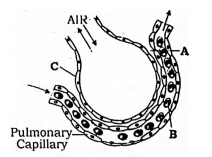
A section of an alveolus with a pulmonary capillary indicates the presence of major layers constituting diffusion membrane-
Q41.
Partial pressures (in mmHg) of O2 in atmospheric air, alveoli, deoxygenated blood, oxygenated blood and tissues are-
Q42.
Partial pressure (in mm Hg) of CO2 in atmospheric air, alveoli, deoxygenated blood, oxygenated blood and tissues are-
Q43.
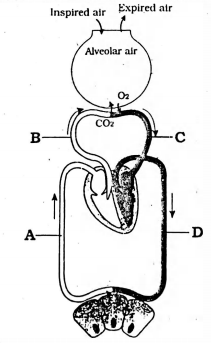
Name the blood vessels A to D.
Q44.
In comparison to solubility of O2 in blood the solubility of CO2 is –
Q45.
Study the given figure and identify A to C.
Q46.
The barrier between the air in alveolus and blood in pulmonary capillary consists of 3 layers and its total thickness is-
Q47.
Total percentage of O2 transported by haemoglobin or RBC is –
Q48.
Besides RBC blood plasma also carries O2 in solution. The percentage is –
Q49.
CO2 is transported –
Q50.
The majority of CO2 is transported as –
Q51.
Blood carries the CO
2 in 3 forms. The correct percentages of CO
2 in these forms are-
| As carbaminohaemoglobin in RBC | As bicarbonates | Dissolved form in plasma |
|---|
| 20 -25% | 70% | 7% |
Q52.
Each molecule of haemoglobin when fully saturated carries how many molecules of O2 –
Q53.
Dissociation curve is associated with –
Q54.
Binding of O2 with haemoglobin is primarily related to –
Q55.
Besides pO2 the other factor(s) affecting the binding of O2 with haemoglobin is/are –
Q56.
Oxygen dissociation curve is –
Q57.
Which of the following statements is wrong?
Q58.
What will be the pO2 and pCO2 in the atmospheric air compared to those in the alveolar?
Q59.
Which of the following would have the same O2 content?
Q60.
CO2 dissociates from carbaminohaemoglobin when –
Q61.
Which of the following situations would result in the greatest degree of O2 saturation for haemoglobin, assuming pO2 remains constant –
Q62.
Which of the following factors favour the formation of oxyhaemoglobin in lungs?
Q63.
All of the following favour the dissociation of oxyhaemoglobin to deliver O2 to tissues except-
Q64.
The transport of CO2 by the blood is primarily dependent on –
Q65.
Which of the following statements is false?
Q66.
Which of the following equation is correct?
Q67.
Which of the following is incorrect about the given graph.
Q68.
Assertion: The maximum pO2 in alveoli is considerably less than in the atmosphere.
Reason: Lungs in mammals do not completely empty with each breath and inhalation occurs through the same airways as exhalation, so each inhalation mixes fresh air with oxygen depleted residual air.
Q69.
How does an increase in the CO2 concentration in the blood affect the pH of CSF?
Q70.
Assertion: A drop in the blood pH causes an increase in heart rate.
Reason: Increased Heart Rate increases the rate at which CO2 is delivered to the lungs, where CO2 is removed.
Q71.
Respiratory process is regulated by certain specialized centres in the brain. One of the following listed centres can reduce the inspiratory duration upon stimulation –
Q72.
Pneumotaxic centre is present in –
Q73.
The breathing centre initiates ventilation in response to –
Q74.
All of the following factors play role in the regulation of respiratory rhythm except –
Q75.
Receptors associated with aortic arch and carotid artery can recognise changes in ______ and ____ conc. and send necessary signal to _______ for remedial action.
Q76.
Respiratory centre of brain is stimulated by-
Q77.
Asthma is caused by –
Q78.
One reason for emphysema is –
Q79.
Emphysema is characterised by –
Q80.
Why do human beings have difficulty breathing at high elevations?
Q81.
Which of the following diseases are occupational respiratory disorder?
Q82.
If an injury tore a small hole in the membrane surrounding lungs, what effect on lung function would you expect?