Q1.
Introduction 1. Which of the following use water from their environment as circulating fluid –

Q2.
Blood, a special type of connective tissue
Q3.
Plasma is a straw coloured, viscous fluid constituting nearly ____ % of blood –
Q4.
The amount of water present in blood plasma is –
Q5.
I. Proteins contribute 6 - 8% of the blood plasma
II. Plasma contains very high amount of minerals
III. Plasma without the clotting factors is called serum
IV Glucose, amino acids, lipids, etc., are also present in the plasma as they are always in transit in the body.
Of the above statements –
Q6.
Match List I with List II and select the correct option.
| List I (Plasma protein) | List II (Functions) |
|---|
| I. Fibrinogen | A. Defense mechanism |
| II. Globulins | B. Osmotic balance |
| III. Albumins | C. Coagulation of blood |
Q7.
Formed elements of blood include –
Q8.
Which of the following statements is false?
Q9.
Life span of human RBC is –
Q10.
What is the amount of haemoglobin present in 100 ml blood of human blood?
Q11.
Mammalian RBCs are in shape-
Q12.
All of the following statement are correct about WBCs except –
Q13.
All of the following are granulocytes except-
Q14.
Match list I with list II correctly –
| List I (Types of leucocytes/WBCs) | List II (Their% of total WBC) |
|---|
| I. Neutrophils | A. 20 - 25 |
| II. Basophils | B. 2 - 3 |
| III. Monocytes | C. 6 - 8 |
| IV. Eosinophils | D. 0.5 - 1 |
| V. Lymphocytes | E. 60 - 65 |
Q15.
Match the following –
| Column I | Column II |
|---|
| I. Basophils | A. Phagocytes |
| II. Neutrophils | B. Secrete histamine, serotonin , heparin and involved in inflammatory response |
| III. Monocytes | C. Resist infections and are also involved in allergic reaction |
| IV. Eosinophils | D. Immunity |
| V. Lymphocytes | E. |
Q16.
Megakaryocytes produce-
Q17.
Which of the following is cell fragments?
Q18.
1 mm3 blood has how many blood platelets?
Q19.
During blood clotting, platelets release –
Q20.
Find the correct descending order of percentage proportion of leucocytes in human blood.
Q21.
Assertion – A physician might order a white cell count for a patient with symptoms of an infection.
Reason- An increase in the number of white blood cells (leukocytes) may indicate that the person is combating an infection.
Q22.
ABO blood grouping is based on the presence or absence of surface antigens
Q23.
Fill up gaps given below in the table-
| Blood group | Antigens on RBCs | Antibody in Plasma | Donor groups |
|---|
| A | A | Anti- B | A,O |
| B | B | Anti-A | B,O |
| AB | AB | ___II____ | A,B,AB,O |
| O | __I__ | ____III____ | ___IV____ |
Q24.
Which of the following blood groups is universal donor and universal acceptors respectively?
Q25.
Which of the following representations is correct about blood groups and donor compatibility?
Q26.
Rh factor is concerned with blood grouping. It derives its name from-
Q27.
Rh factor is responsible for-
Q28.
In developing foetus, erythroblastosis foetalis is caused by-
Q29.
In erythroblastosis foetalis, which of the following factors passes through placenta into foetus -
Q30.
A doctor suggested to a couple not to have more than one child because of –
Q31.
In case of emergency which blood group could be safely transfused?
Q32.
Which of the following is expected if husband is Rh+ and wife is Rh-?
Q33.
Which of the following statements is correct?
Q34.
What is the correct order of these events?
1. Conversion of fibrinogen to fibrin
2. Clot retraction and leakage of serum
3. Thromboplastin formation
4. Conversion of prothrombin to thrombin
Q35.
Which of the following statement are correct?
I. Ca+2 is necessary for blood coagulation
II. Coagulation in blood vessel is prevented during normal condition by heparin
III. Clotting of blood involves changes of fibrinogen to fibrin by thrombin
IV. Blood clotting involves cascading process involving a number of factors present in the active form always
Q36.
Which of the following pathways is correct for blood clotting
Q37.
Which of following statements is wrong about lymph.
I. Lymph is colourful as it has haemoglobin but no RBC
II. The fluid present in lymphatic system is called lymph
III. It contains specialized lymphocytes which are responsible for immunity of the body
IV. Lymph is an important carrier for nutrients and hormones
V. Fats are absorbed through lymph in the lacteals present in the intestinal villi
Q38.
Which of the following statements is correct?
I. Lymphatic system collects tissue fluid/interstitial fluid and drains it back to the major veins
II. Interstitial fluid (tissue fluid) and lymph have almost similar composition
III. Lymph and interstitial fluid have no larger proteins and RBC
IV. Exchange of nutrients and gases, etc. between the blood and cells always occurs through tissue fluid
V. Interstitial fluid has the same mineral distribution as that in plasma
VI. Lymph can be defined as blood minus RBC but has specialized lymphocytes
Q39.
Open circulatory system is found in –
Q40.
Closed circulatory system is found in –
Q41.
In an open circulatory system –
Q42.
Advantages of closed circulatory system over open circulatory system includes which of the following?
Q43.
Which of the following statements is wrong about the closed circulatory system?
Q44.
Following are figures of hearts in different animals
A= Auricle
V = Ventricle
Identify with their characteristic hearts –
Q45.
In fishes the blood circulation is represented as -
The above flow of blood indicates it is a
Q46.
Incomplete double circulation is found in which of the following animals?
Q47.
Which of the following statements is not true?
Q48.
Which of the following is correct about human heart?
Q49.
Bicuspid valve / mitral valve is found between -
Q50.
Tricuspid valve is present between the-
Q51.
Chordae tendinae are found in –
Q52.
Ventricles are thick-walled as compared to atrium because -
Q53.
Which of the following has thickest wall?
Q54.
Match the following.
| Column I | Column II |
|---|
| A. Superior vena cava | p. carries deoxygenated blood to lungs |
| B. Inferior vena cava | q. carries oxygenated blood from lungs |
| C. Pulmonary artery | r. brings deoxygenated blood from lower part of body to right atrium |
| D. Pulmonary vein | s. bring deoxygenated blood from upper part of body to right atrium |
Q55.
Origin of heart beat and its conduction is represented by -
Q56.
'Heart of heart' is -
Q57.
SA node is located in –
Q58.
SA node is called pace maker of the heart. Why?
Q59.
Sino-atrial node (SAN) can generate impulses -
Q60.
The impulse of heart beat originate from –
Q61.
Rate of heart is determined by-
Q62.
Bundle of His is a group of-
Q63.
Bundle of His / AV-bundle found in –
Q64.
Atria-ventricular node (AVN) is situated in
Q65.
Purkinje fibres are present in -
Q66.
The chordae tendinae-
Q67.
Which of the following correctly traces the electrical impulses that trigger each heart beat
Q68.
An atrioventricular valve prevents the back flow or leakage of blood from –
Q69.
How many double circulations are normally completed by the human heart in one minute?
Q70.
Assertion- If you trace the path of a molecule of carbon dioxide that starts in an arteriole in the right thumb and leaves the body in exhaled air, the minimum number of capillary beds the molecule encountered is 2.
Reason- The molecule of carbon dioxide would need to enter a capillary bed in the thumb before returning to the right atrium and ventricle, then travel to the lung and enter a capillary from which it would diffuse into an alveolus and be available to be exhaled.
Q71.
The duration of cardiac cycle in a normal man is -
Q72.
During systole of heart -
Q73.
During ventricular systole –
Q74.
Contraction of right ventricle pumps blood into-
Q75.
When ventricular systole occurs –
Q76.
During cardiac cycle about % of ventricular filling occurs prior to atrial contraction. _____ % ventricular filling occurs due to atrial contraction –
Q77.
Which of the following events do not occur during joint diastole?
I. All 4 chambers of heart are in relaxed state
II. Tricuspid and bicuspid valves open
III. Action potential is conducted from SAN to AVN
IV. Blood from the pulmonary veins and vena cava flows into the left and right ventricles respectively through the left and right atria
V. The Semilunar valves are closed
Q78.
The accompanying diagram shows three stages in the cardiac cycle-
Which of the following sequence is correct?
Q79.
Cardiac output is determined by –
Q80.
The amount of blood to be pumped out by each ventricle/minute is-
Q81.
During cardiac cycle each ventricle pumps out about 70 ml of blood which is called -
Q82.
A red blood cell, entering the right side of the heart passes by or through the following structures –
1. Atrioventricular valves
2. Semi-lunar valves
3. Right atrium
4. Right ventricle
5. SAN
Q84.
Which of the following statement is not true?
Q85.
First cardiac sound (lub) is associated with -
Q86.
Which of the following statement is wrong for second cardiac sound?
Q87.
Assertion - The AV node delay the electrical impulse moving from the SA node and the atria to the ventricles.
Reason- The delay allows the atria to empty completely, filling ventricles fully before they contract.
Q88.
Electrocardiogram is a measure of-
Q89.
Which of the following is a false statement?
Q91.
QRS complex represents the -
Q92.
T wave on an ECG represents –
Q93.
The below figure is the diagrammatic representation of standard ECG.
| Column I | Column II |
|---|
| A. P- wave | I. Ventricular depolarization followed by ventricular contraction |
| B. QRS Complex | II. Atrial depolarization followed by systole of both atria |
| C. T- wave | III. Ventricular repolarization followed by ventricular relaxation |
Q94.
Match the Column I with Column II –
| Column I | Column II |
|---|
| A. Counting the number of QRS complex in a given time period | I. A detailed evaluation of the heart function |
| B. Potential generated by the recovery of ventricles from the depolarization state | II. Determination of heart beat |
| C. Multiple leads are attached to the chest region | III. T-wave |
Q95.
Which of the following options represents the pulmonary circulation in human being –
Q96.
Which of the following options represent correct systemic circulation in human being-
Q97.
Note the following blood vessels –
A. Arteriole B. Capillary
C. Aorta D. Muscular artery
E. Vein F. Venule
Choose the correct path that lists the blood vessels in. order, blood passes through them as it leaves the heart, travels to tissue and returns to heart -
Q98.
Identify X, Y and Z?
Q99.
Systemic circulation -
Q100.
The blood circulation which starts and ends into capillaries is -
Q101.
Vascular connection between the digestive tracts and liver is called –
Q102.
The hepatic-portal vein carries blood from ____ to the ____ before it is delivered to the systemic circulation-
Q103.
A special coronary system of blood vessels present in our body exclusively for the circulation of blood to and from the-
Q104.
Assertion- The heart of a normally developing human fetus has a hole between the left and right atria. In some cases, this hole does not close completely before birth. If the hole weren’t surgically corrected, the O2 content would be abnormally low.
Reason- In this case, some oxygen depleted blood returned to the right atrium from the systemic circuit would mix with the oxygen rich blood in the left atrium.
Q105.
Assertion – There is low velocity of blood flow in the capillaries.
Reason – There is large total cross-sectional area of the capillaries.
Q106.
Cardiac centre lies in -
Q107.
Cardiac centre can moderate. the cardiac functions through -
Q108.
Neural signal through the sympathetic nerve (part of ANS) increases cardiac output because of-
Q109.
Parasympathetic neural signal decreases cardiac output by -
Q110.
Heart beat increases -
Q111.
In adult, normal blood pressure is –
Q112.
Normal BP= 120 / 80 mmHg in an adult. In this measurement 120 mmHg is the ____ pressure and 80 mmHg is _______ pressure-
Q113.
Which one indicates B.P or hypertension?
Q114.
Option |
A |
B |
C |
D |
|---|
(a) |
Systemic vein |
Pulmonary artery |
Pulmonary vein |
Systemic artery |
(b) |
Systemic artery |
Pulmonary artery |
Pulmonary vein |
Systemic vein |
(c) |
Pulmonary artery |
Systemic vein |
Pulmonary vein |
Systemic artery |
(d) |
Systemic vein |
Pulmonary vein |
Pulmonary artery |
Systemic artery |
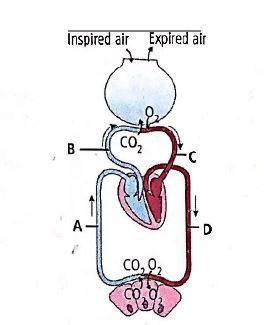
Q115.
It is often referred as atherosclerosis, affects the blood vessels that supply blood to the heart muscles. It is caused by deposition of Ca, fat, cholesterol and fibrous tissues making the lumen of arteries narrow –
The above facts are related to-
Q116.
Assertion – Nitroglycerin relieve chest pain caused by narrowing of the cardiac arteries.
Reason – The chest pain results from inadequate blood flow in coronary arteries. Vasodilation promoted by nitric oxide from nitroglycerin increases blood flow, providing the heart muscle with additional oxygen and thus relieving the pain.