Q1.
Match the following columns and select the correct option.
Column-I - Column-II
(A) Eosinophils - (i) Immune response
(B) Basophils - (ii) Phagocytosis
(C) Neutrophils - (iii) Release histaminase, destructive enzymes
(D) Lymphocytes - (iv) Release granules containing histamine
Q2.
Match the items given in column I with those in column II and select the correct option given below.
Column I - Column II
A. Fibrinogen - (i) Osmotic balance
B. Globulin - (ii) Blood clotting
C. Albumin - (iii) Defence mechanism
Q3.
Adult human RBCs are enucleate. Which of the following statement(s) is/are most appropriate explanation for this feature?
(1) They do not need to reproduce.
(2) They are somatic cells.
(3) They do not metabolise.
(4) All their internal space is available for oxygen transport.
Q4.
Name the blood cells, whose reduction in number can cause clotting disorder, leading to excessive loss of blood from the body.
Q5.
Serum differs from blood in
Q6.
Erythropoiesis starts in
Q7.
Person with blood group AB is considered as universal recipient because he has
Q8.
The figure shows a human blood cell. Identify it and give its characteristics.

Q9.
A certain road accident patient with unknown blood group needs immediate blood transfusion. His one doctor friend at once offers his blood. What was the blood group of the donor?
Q10.
Which one of the following human organs is often called the "graveyard" of RBCs?
Q11.
Which one of the following plasma proteins is involved in the coagulation of blood?
Q12.
A person with unknown blood group under ABO system, has suffered much blood loss in an accident and needs immediate blood transfusion. His friend who has valid certificate of his own blood type, offers for blood donation without delay. What would have been the type of blood group of the donor friend?
Q13.
Which two of the following changes (i –iv) usually tend to occur in the plain dwellers when they move to high altitudes (3,500 m or more)?
(i) Increase in red blood cell size
(ii) Increase in red blood cell production
(iii)Increased breathing rate
(iv) Increase in thrombocyte count
Q14.
The haemoglobin content per 100 mL of blood of a normal healthy human adult is
Q16.
Globulins contained in human blood plasma are primarily involved in
Q17.
The most popularly known blood grouping is the ABO grouping. It is named ABO and not ABC, because "O" in it refers to having
Q18.
The most active phagocytic white blood cells are
Q19.
Which type of white blood cells are concerned with the release of histamine and the natural anticoagulant heparin?
Q20.
A drop of each of the following, is placed separately on four slides. Which of them will not coagulate?
Q21.
You are required to draw blood from a patient and to keep it in a test tube for analysis of blood corpuscles and plasma. You are also provided with the following four types of test tubes. Which of these you will not use for the purpose?
Q22.
In the ABO system of blood groups, if both antigens are present but no antibody, the blood group of the individual would be
Q23.
What is correct for blood group O?
Q24.
Erythroblastosis fetalis is caused when fertilisation takes place between gametes of
Q25.
Which statement is true for WBC?
Q26.
Which is the principal cation in the plasma of the blood?
Q27.
The blood group, with antibody-A and antibody-B is
Q28.
The problem, due to Rh– factor arises when the blood of two (Rh+ and Rh–) mix up
Q29.
Which of the following is agranulocyte?
Q30.
The life span of human WBC is approximately
Q31.
Vitamin K is required for
Q32.
Cells formed in bone marrow include
Q33.
Component of blood responsible for producing antibodies is
Q35.
Carbonic anhydrase occurs in
Q36.
Removal of calcium from freshly collected blood would
Q37.
A person with blood group A requires blood. The blood group which can be given is
Q38.
Which one engulfs pathogens rapidly?
Q39.
Child death may occur in the marriage of
Q40.
Breakdown product of haemoglobin is
Q41.
RBCs do not occur in
Q42.
Which one of the following is correct?
Q43.
Compared to blood our lymph has
Q44.
Which of the following statements is true for lymph?
Q45.
Which of the following is not the main function of lymph glands?
Q47.
Lymph differs from blood in possessing
Q48.
The QRS complex in a standard ECG represents
Q49.
Match the column - I with column - II.
Column-I - Column-II
(A) P-wave - (i) Depolarisation of ventricles
(B) QRS complex - (ii) Repolarisation of ventricles
(C) T-wave - (iii) Coronary ischaemia
(D) Reduction in the size of T-wave - (iv) Depolarisation of atria
(v) Repolarisation of atria
Q50.
What would be the heart rate of a person if the cardiac output is 5 L, blood volume in the ventricles at the end of diastole is 100 mL and at the end of ventricular systole is 50 mL?
Q51.
Match the items given in column I with those in column II and select the correct option given below.
Column I - Column II
A. Tricuspid valve - (i) Between left atrium and left ventricle
B. Bicuspid valve - (ii) Between right ventricle and pulmonary artery
C. Semilunar valve - (iii) Between right atrium and right ventricle
Q52.
Doctors use stethoscope to hear the sounds produced during each cardiac cycle. The second sound is heard when
Q53.
Blood pressure in the mammalian aorta is maximum during
Q54.
The diagram given here is the standard ECG of a normal person. The P-wave represents the
Q55.
'Bundle of His' is a part of which one of the following organs in humans?
Q56.
Given below is the ECG of a normal human. Which one of its components is correctly interpreted below?
Q57.
If due to some injury the chordae tendinae of the tricuspid valve of the human heart is partially non-functional, what will be the immediate effect?
Q58.
In a standard ECG which one of the following alphabets is the correct representation of the respective activity of the human heart?
Q59.
In humans, blood passes from the post caval to the diastolic right atrium of heart due to
Q60.
Which one of the following has an open circulatory system?
Q61.
The cardiac pacemaker in a patient fails to function normally. The doctors find that an artificial pacemaker is to be grafted in him. It is likely that it will be grafted at the site of
Q62.
Bundle of His is a network of
Q63.
Systemic heart refers to
Q64.
Impulse of heart beat originates from
Q65.
Rate of heart beat is determined by
Q66.
The correct route through which pulse-making impulse travels in the heart is
Q67.
The neurogenic heart is the characteristic feature of
Q68.
The heart sound 'dup' is produced when
Q69.
The pacesetter in the heart is called
Q70.
Tricuspid valve is found in between
Q71.
The hepatic portal vein drains blood to liver from
Q72.
Blood pressure in the pulmonary artery is
Q73.
In mammals, which blood vessel would normally carry largest amount of urea?
Q74.
Which one of the following animals has two separate circulatory pathways?
Q75.
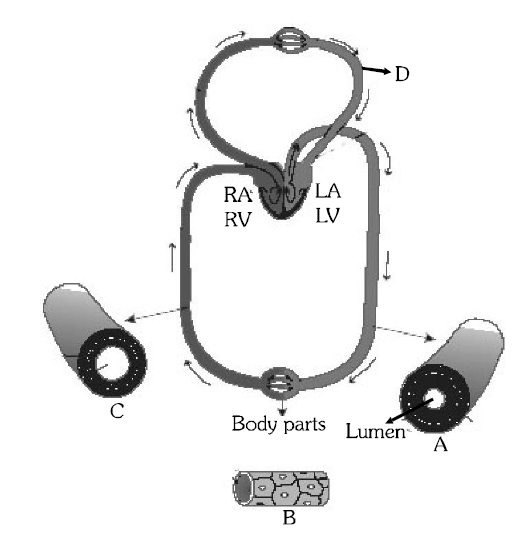
The given figure shows schematic plan of blood circulation in humans with labels A to D. Identify the label and give its functions.
Q76.
The figure shows blood circulation in humans with labels A to D. Select the option which gives correct identification of label and functions of the part.
Q77.
Arteries are best defined as the vessels which
Q78.
Fastest distribution of some injectible material/medicine and with no risk of any kind can be achieved by injecting it into the
Q79.
Difference between pulmonary artery and pulmonary vein is that, the pulmonary artery has
Q80.
In which point, pulmonary artery is different from pulmonary vein?
Q81.
Which vertebrate organ receives only oxygenated blood?
Q82.
In veins, valves are present to check backward flow of blood flowing at
Q83.
Blood capillaries are made of
Q84.
Wall of blood capillary is formed of
Q85.
Splenic artery arises from
Q86.
A vein possesses a large lumen because
Q87.
Arteries carry oxygenated blood except
Q88.
How do parasympathetic neural signals affect the working of the heart?
Q89.
Which one of the following statements is correct regarding blood pressure?
Q90.
Given below are four statements (i-iv) regarding human blood circulatory system.
(i) Arteries are thick-walled and have narrow lumen as compared to veins.
(ii) Angina is acute chest pain when the blood circulation to the brain is reduced.
(iii)Persons with blood group AB can donate blood to any person with any blood group under ABO system.
(iv) Calcium ions play a very important role in blood clotting.
Q91.
The thickening of walls of arteries is called
Q92.
An adult human with average health has systolic and diastolic pressures as